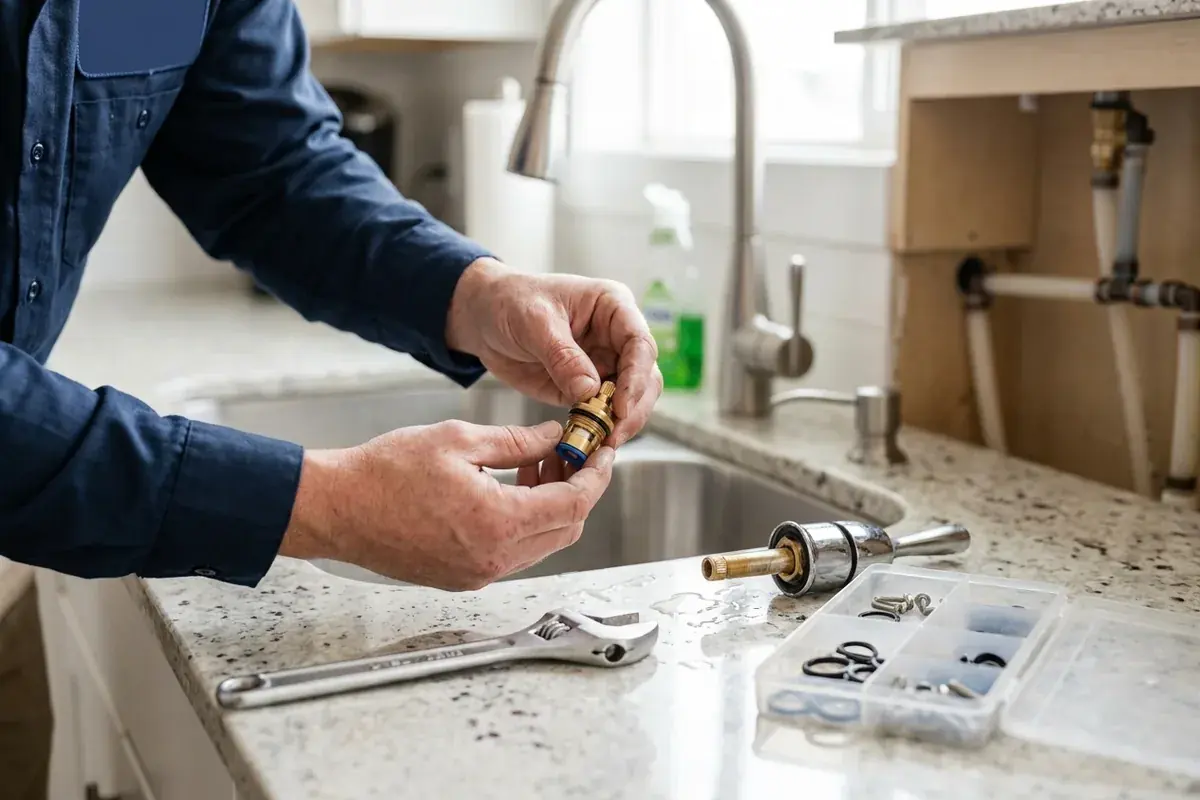
Most drips are cheap to fix, and a few are not
A faucet drip feels minor until you notice the bill or the stain in the basin. Inside the body, a washer, a ceramic disc or a cartridge controls the flow, and rubber seals and O-rings keep water from escaping around the handle. When one of those wears out, you get a drip at the spout or a slow weep around the base.
Replacing a cartridge is a sensible DIY job when you can shut off the supply and your faucet has a common design. It goes wrong when the stop valve will not close, when the handle seizes on its stem, or when corrosion locks the parts together. At that point, forcing it can snap a supply line behind the wall.
Salt air also plays a part for homes near Main Beach and The Cove. Chrome and brass fittings pit and crust faster in a coastal climate, so a faucet that looks fine may have a stuck stem underneath.
What to do when the faucet will not shut off or the cabinet is filling
A fixture that cannot be turned off is a flood in slow motion. Your goal in the first minutes is to isolate the water, not to fix the part.
Find the angle stop
Under a sink, each supply line has a small valve called an angle stop. Turn it clockwise until it stops. If it turns freely without slowing the flow, it has failed and you need the next valve upstream.
Close the main
If the stop is stuck or missing, shut the main water valve where the line enters the building. Open a low faucet afterward to bleed off pressure.
Empty and dry the cabinet
Remove cleaning products and boxes, and put a bowl under any active drip. Wet particleboard swells quickly, so move fast and wipe the floor of the cabinet.
Note where the water is coming from
Watch whether it is the faucet, a supply line, the trap or the sink rim. A quick photo helps us arrive with the right parts.
If water is running near an outlet, a garbage disposal switch or an appliance cord, keep clear until the power is off at the breaker. Tell us on the phone, and we will adjust how we approach the job.
Where faucets and sinks leak around a Florida home
Leaks hide in different places on different fixtures. This is the list we work through when someone describes a wet spot.
- Kitchen and bathroom faucet bodies Drips at the spout or oozing at the base usually mean a worn cartridge or seal that we can replace.
- Shower valve and showerhead Constant dripping from the head or a handle that will not stay off points to a bad cartridge inside the wall valve.
- Bathtub spout and diverter Water from the spout while the shower runs means the diverter has worn, and a loose spout can leak behind the wall.
- Outdoor spigots and hose bibs A hose bib that drips at the handle or sprays behind the hose needs new packing or a new valve, since the leak runs into the wall.
- Laundry and utility sinks Faucets, supply lines and washing machine valves share a corner of the house, and any one of them may be the source.
- Refrigerator water line The small valve behind a fridge or at the wall feeds the ice maker, and a drip there often goes unseen.
- Sink drain, trap and basket strainer A wet bottom of the cabinet with a dry faucet points down at the trap, a slip nut or the drain flange.
A slow or standing drain at a sink is a different problem, and our drain cleaning team handles clogs in the trap and the line beyond.
Fix, swap or replace the whole faucet
Not every leak deserves a new faucet, and not every old faucet deserves another repair. This is how the choice usually plays out.
| Problem | Usual fix | Reason |
|---|---|---|
| Drip from the spout | Replace cartridge or seat | The moving part has worn, not the faucet body |
| Loose or wobbly handle | Tighten or replace the set screw and stem | Most are mechanical and quick |
| Corroded body or cracked spout | Replace the faucet | Parts will not hold once the body is pitted |
| Leaking supply line | Replace the line and check the stop | Braided lines wear out at the ends |
| Stuck or dripping angle stop | Replace the valve | A stop that cannot close defeats its purpose |
| Leak from a shower valve | Replace cartridge or valve body | Behind-the-wall work, so we confirm the cause first |
If a faucet is more than a few cartridges old, replacement can be the cleaner choice.
How we replace a faucet or valve
A replacement is straightforward when each step is done in order and the old connections are tested before the new ones go on.
- 1
Isolate and drain
We close the stops, open the faucet, and clear the cabinet so we can work without kneeling in water.
- 2
Remove the old unit
We disconnect the supply lines, loosen the mounting nuts and lift the faucet out, checking for corrosion on the sink deck.
- 3
Prepare the connections
We replace tired supply lines and stops, clean the mounting surface and dry-fit the new faucet.
- 4
Install and seal
The new faucet is set, tightened evenly and connected, with plumber's putty or a gasket where the base meets the sink.
- 5
Flush and test
We run both hot and cold, check each joint with a dry paper towel, and clear any debris from the aerator.
Small leaks, condos and shared walls
A small leak under a sink in a condo can reach the unit beneath it, especially in buildings around Hillsboro Cove and Crystal Lake. Shared walls and stacks may belong to the association, so ask before opening any wall that touches a common line.
If an angle stop will not close and the main is your only option, we can talk through burst pipe repair options when the supply pipe itself is damaged. For homes to the west, our Coconut Creek page explains how we reach you.
Price factors for faucet and sink work
A cartridge swap and a full faucet replacement with new stops are very different jobs. You get a clear price before work starts.
Homeowners policies often cover sudden water damage from a failed supply line or valve, but they usually do not pay for the worn faucet itself. Check your policy and photograph any damage before cleanup.
Slow drips that run for months are often treated as maintenance, not accidents, so fixing a leak early protects both your home and any later claim.
Want your real number? Call us and describe the job.
(561) 448-8545Faucet and sink questions from Deerfield Beach homeowners
Yes. Our emergency line is open 24/7, including nights, weekends and holidays, and we offer same-day appointments when available. We do not promise an exact arrival time, since it depends on active calls and crew locations.
Call (561) 448-8545, and we will help you shut the water off while we plan the visit.
Often, yes. If the stops close fully and you can find the right cartridge, it is a reasonable weekend job. Bring the old one to the parts counter so the match is exact.
Call us if the handle is seized, the stop will not close, or the valve is inside a tiled shower wall.
That usually means a worn hot-side seat or cartridge. Hot water softens and wears rubber seals faster, so one side often fails before the other.
A cartridge or seat replacement normally fixes it without a new faucet.
Close the shut-off valve inside the house if there is one, or the main valve if there is not. A hose bib that leaks at the handle needs new packing or a replacement, and one that leaks into the wall should be fixed right away.
If the supply pipe behind it is damaged, our burst pipe repair service covers that.
Look at the trap, the slip nuts, the basket strainer and the dishwasher or disposal connections first. Dry the area and run water for a few minutes while a paper towel sits under each joint.
If the leak is at the trap or if the sink drains slowly, our drain cleaning team can help.
Yes. Bring the faucet and its parts, and tell us the sink hole layout. We replace the stops and supply lines at the same time when they are worn, because a new faucet on a failing stop is a short-lived fix.
For larger fixture projects, see our plumbing installation page.