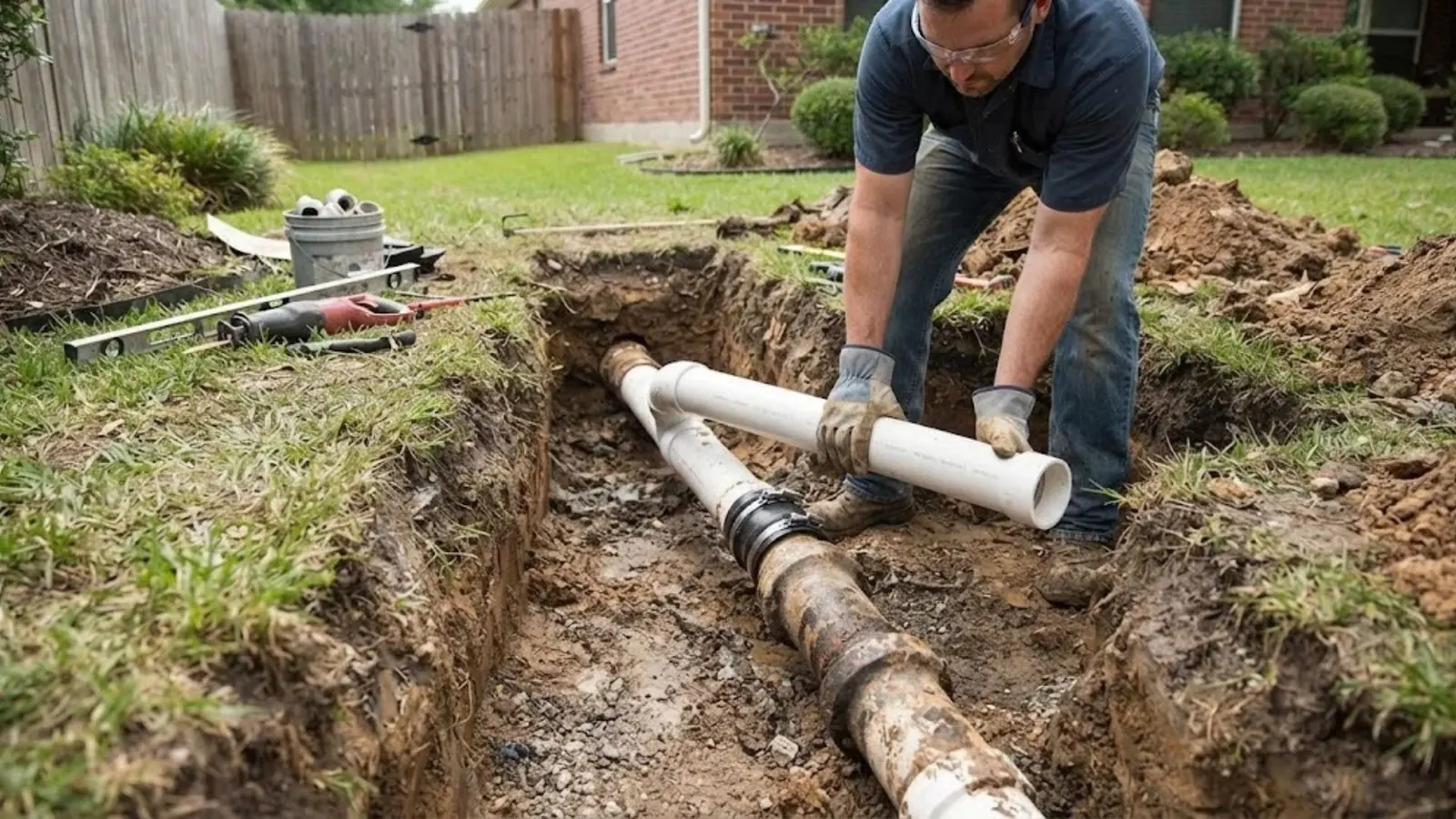
Sewage is coming up or the yard is sinking
A damaged sewer line is different from an ordinary clog because the pipe itself is failing. These steps limit health risk and damage until we arrive.
Stop all water use
Every flush or shower sends more wastewater toward a broken pipe. Ask everyone in the building to stop, including neighbors who share the line.
Keep people and pets away
Sewage carries bacteria. Keep children and animals out of wet areas, wear gloves if you must touch anything, and wash hands thoroughly afterward.
Look outside
A wet, sunken or foul-smelling patch of lawn, or a cleanout that is overflowing, tells us roughly where the line has failed. Take a photo and mark the spot, but do not dig.
Do not use drain chemicals
A broken line cannot be cleared with liquid cleaners, and the chemicals only make later work more hazardous.
In a condo or townhome, call the association too. A failed lateral serving several units is a building matter, and they will need to approve any dig or repair.
How a sewer pipe fails
Sewer lines are out of sight until something goes wrong. These are the failures we see most often.
Cracked or broken pipe
Soil movement, heavy loads and age crack rigid pipe. Wastewater leaks out, and soil can wash in and block the flow.
Offset or separated joints
When sections shift out of line, a lip forms that snags paper and solids. Repeated clogs at the same spot are the classic sign.
Root intrusion
Roots follow moisture to a joint, grow inside the pipe and slowly choke it. Cutting them clears the pipe, but the opening remains.
Bellies and sags
A low spot holds water and waste, so the line clogs after every few uses even though it is not broken.
Collapsed sections
A pipe that has caved in cannot be cleared by any tool. Water backs up and does not recover after a cleaning.
Corrosion in older metal lines
Cast iron flakes and thins from the inside, narrowing the bore until it is more rust than pipe.
Why repairs here come with local complications
Many Deerfield Beach homes and condos sit on concrete slabs, so part of the drain system runs beneath the floor. A break under the slab can mean opening the concrete, or finding another path for the line.
Yards near the Hillsboro Canal and other waterways can sit above a high water table. Wet soil makes trenches unstable, and groundwater can seep into a dig and slow the work. We plan for it by pumping the trench and shoring where needed.
Large trees are the other local factor. Roots from mature trees in a front yard can find a joint and invade it, so we look at where the tree sits in relation to the line before we recommend a fix.
From the first camera look to a finished repair
We follow a clear order so you understand why each step happens and what it adds to the job.
- 1
Camera the line
A push camera shows us the break, its depth along the run and the condition of the surrounding pipe. See our sewer camera inspection page for what the video shows.
- 2
Locate the problem above ground
Locating tools track the camera head from the surface, so we know exactly where to dig or where to bring in lining equipment.
- 3
Choose the method with you
We lay out the choices, from spot repair to lining to full replacement, with honest trade-offs for your pipe and your site.
- 4
Do the work
We excavate, line or replace the section, and reconnect it to the existing pipe using materials that suit the line.
- 5
Prove it worked
We run a camera pass afterward and flow-test the line so you can see the repair and confirm that wastewater moves freely.
Trenchless lining or open trench
Both methods can restore a line. Neither is always the better choice, and we explain which suits your property.
Trenchless pipe lining
- Cured liner forms a new pipe inside the old one
- Smaller access holes, less yard and driveway disruption
- Works best when the pipe is still in line
- Does not suit a badly collapsed or offset pipe
- Can slightly reduce the pipe's inner diameter
Open trench replacement
- New pipe replaces the old from end to end
- Fixes bellies, offsets and collapses directly
- Needs digging through lawns, landscaping or hardscape
- Wet ground may slow the work and add shoring
- Surface restoration is a separate step
No method is a promise of how long a pipe will last. We explain why we favor one approach for your line and what could change that recommendation once we see more.
Repair, lateral replacement, or both
A short crack or one bad joint is often a spot repair. If the camera shows several defects, a belly, or pipe that is failing along its length, replacing the whole lateral from the building to the connection is usually the better long-term answer. Patching one spot on a failing line only moves the problem down the pipe.
Roots add a wrinkle. If they entered through a single failed joint, we can repair that joint. If many joints have separated, ongoing cleaning will keep recurring, and our sewer line cleaning service can hold the line open only as a stopgap while you plan the larger fix.
Condo owners should know that a lateral serving several units often belongs to the association. We work with managers on scope and access, and our Coconut Creek page explains how we serve multi-unit properties to the west.
What affects the price of sewer line repair
Sewer repairs span a wide spread, from a small spot fix to a full lateral replacement. We give a clear price before work starts, once the camera has shown what is wrong.
Homeowners policies often exclude the repair of a worn or cracked sewer line, though they may respond to sudden damage from a backup. Check your policy and ask about sewer line or service line endorsements.
Keep the camera video and our written findings, because your insurer or association will probably want them.
Want your real number? Call us and describe the job.
(561) 448-8545Sewer line repair questions from Deerfield Beach owners
Yes. Our emergency line is open 24/7, including nights, weekends and holidays, and we offer same-day appointments when available. We do not promise an exact arrival time because it depends on where our crews are and how many calls are active.
Call (561) 448-8545, and we will tell you what to do with the water while we plan the visit.
A clog usually clears and stays clear for a while. A broken line clogs again and again, sometimes at the same place, and may come with wet patches in the yard or a sunken area. A camera is the way to be sure.
Sometimes. Trenchless lining uses small access points and avoids a long trench, but it suits pipe that is still in line. A collapsed or badly offset pipe often needs a section replaced.
We explain which applies after we see the line on camera.
It varies. A lateral that serves only your property is often yours up to the connection point, while shared lines in a condo community often belong to the association. Ask the association or the City of Deerfield Beach to confirm before you commit to work.
Roots enter where the pipe has an opening. If we replace or line the pipe so those openings are sealed, the main entry points are removed. If the roots entered through one joint and the rest is sound, repairing that joint may be enough. See our hydro jetting page for how we clear roots before a repair.
Not always. If the break is in the yard or at the cleanout, we repair it outside. If it is under the slab, we compare opening the concrete with rerouting the line, and we explain the trade-offs before you decide.
Yes. We serve condos, townhomes and houses in Deerfield Beach and nearby towns. See our service areas page for the list, and give us your street and ZIP when you call.