A high water bill and a meter that keeps moving
The most common sign of a hidden leak is not a puddle at all. It is a bill that jumps with no change in how many people live in the home, or a meter dial that creeps forward while every tap is off. Water that leaves through a cracked line, a leaking toilet flapper or a failed irrigation fitting still gets counted, whether you see it or not.
You can run a simple check yourself. Close every faucet, stop the dishwasher and washer, and note the meter reading or the position of the small leak indicator on the dial. Wait two hours without using any water, then look again. If the number moved or the indicator is still spinning, water is escaping somewhere between the meter and your fixtures, or inside a fixture.
A toilet that runs silently is the cheapest cause to rule out, so drop a little food coloring in the tank and see if color reaches the bowl without flushing. If the bowl stays clear and the meter still moves, the leak is in a pipe, and that is where detection equipment earns its keep.
Water is coming through a ceiling, wall or floor right now
Active water behind a finished surface causes damage fast, because drywall, insulation and flooring wick moisture far beyond the visible stain. A few quick actions limit the spread while we get to you.
Close the main and check the meter
Shut the main valve where the line enters the building, then see whether the meter stops. If it keeps moving with the main closed, the leak is on the street side of your valve, and we need to know that.
Protect what is below the stain
Move furniture and electronics away, set a bucket under any drip, and keep lights off in a room where a ceiling is sagging. A bulging ceiling can release a lot of water at once, so stay out from under it.
Do not drill to look
Poking holes in drywall for a peek often misses the real source and adds repair work. Leave the surface alone and let us trace the leak with equipment first.
Capture evidence
Photograph the stain, the meter and any visible moisture, with a date stamp if your phone offers one. Your insurer will want a record of when you first noticed it.
Living in a condo and the water seems to come from the unit above? Tell your property manager at once. We can still help, but shared lines usually need the association's approval before anyone opens a wall.
Quick checks to run before we arrive
These take about ten minutes and give us a head start. None of them need tools, and none replace a proper survey.
- Record the meter number Write down the full reading, then check it again after two hours of no water use.
- Look at the leak indicator A small triangle or wheel on the meter face turns whenever any water passes, even a thin trickle.
- Test each toilet A few drops of food coloring in the tank show whether the flapper is letting water slip into the bowl.
- Check the water heater area Look for damp insulation, a wet pan or a slow drip from the relief valve discharge pipe.
- Inspect outdoor spigots and irrigation Wet patches, soft turf or a sprinkler zone that stays muddy point to a buried fitting.
- Walk the house with your hand Feel for warm or damp floor spots, cold wet baseboards and walls that feel clammy compared with the room next to them.
Write down anything odd, such as a hiss at night or a pressure drop in one bathroom. Small clues often narrow the search a lot.
Where hidden leaks usually turn up
Water finds the easiest path, and in South Florida that path is often a slab, a wall cavity or a buried line. These are the places we search most.
Meter box and curb stop leaks
The box where your meter sits can hide a weeping union, a cracked valve or a fitting that sweats all year. Water pooling in the box, or a patch of lawn that stays green and wet, is the usual clue. Leaks on the utility side of the meter typically belong to the utility, so we help you work out which side the water is on.
Leaks behind ceilings and walls
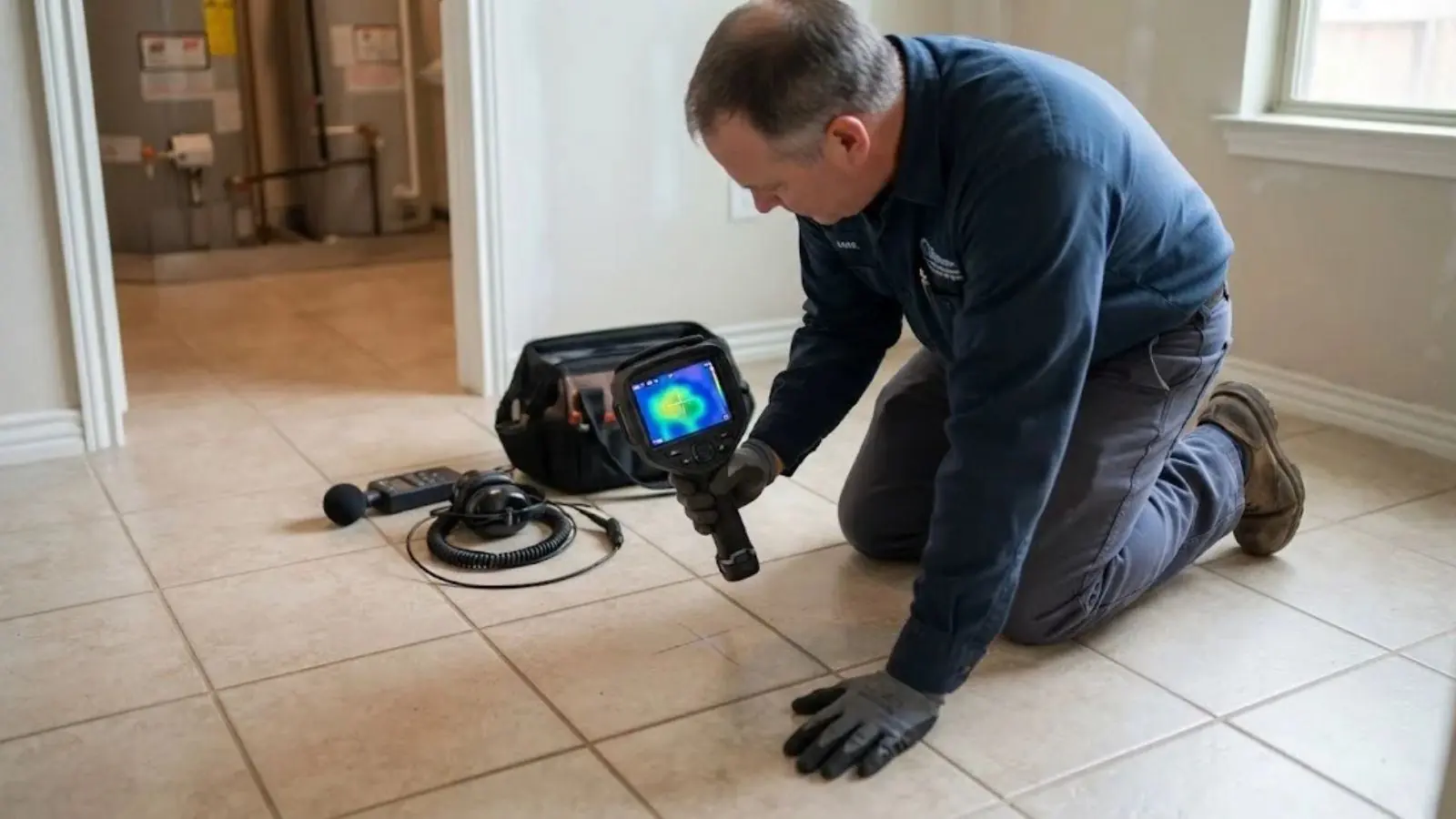
A supply line in a wall can drip slowly for weeks while paint bubbles and baseboards swell. We use moisture meters and thermal imaging to map the wet area, then acoustic listening to find the exact joint.
Raised floors and crawlspaces
Where a home has a raised floor, a crawlspace or an accessible underfloor area, we can often inspect the lines directly with a light and a camera. It is a quicker path than detection through concrete, though not every local building has that kind of access.
Buried supply line leaks
The pipe from the meter to the house runs underground, and a leak there can go unseen for months. Listening tools pick up the sound of water escaping from the pipe, and we confirm with pressure isolation before anything is dug. For the repair side, see water service line repair.
Irrigation and sprinkler lines
Sprinkler zones lose water through cracked risers, broken heads and glued joints that let go under pressure. A zone-by-zone pressure check shows which branch is leaking, so we do not trench the whole yard.
Pool and spa supply lines
We trace the water supply lines that feed pool equipment, auto-fill lines and spa connections. We do not inspect or repair pool shells, so if the leak is in the pool structure itself, we will say so and point you to a pool specialist.
Leak types, warning signs and how we locate each
The method has to match the pipe. This table shows what we usually reach for first.
| Where the leak is | What you may notice | How we find it |
|---|---|---|
| Inside a wall or ceiling | Stains, bubbling paint, musty smell | Moisture meter, thermal imaging, acoustic listening |
| Under a concrete slab | Warm floor spots, running sound, high bill | Acoustic listening, pressure isolation, thermal imaging |
| Buried line to the house | Soft ground, low pressure, moving meter | Ground microphone, line isolation, tracer gas if needed |
| Irrigation system | Soggy turf, weak sprinkler heads | Zone pressure testing, visual checks at fittings |
| Meter box or main valve | Pooled water in the box, constant spinning dial | Visual inspection, meter shut-off test |
| Fixtures and appliance lines | Silent running toilet, damp cabinet | Dye test, fixture isolation, visual check |
Several methods are often combined, because one reading alone can mislead.
Slab leaks and the problem with concrete floors
Many Deerfield Beach homes and condos sit on concrete slabs, so a supply line can run through or beneath the floor. A leak there can warm one patch of tile, lift a section of laminate, or push up a hairline crack. It can also run for a long time before anyone connects it to a rising water bill.
We narrow the search from the outside first. Acoustic equipment listens at the floor surface along the suspected route, thermal imaging shows warm spots from a hot line, and pressure isolation tells us which branch is losing pressure. Our detailed page on slab leak repair covers the options once the leak is located.
We do not break concrete on a hunch. The point of detection is to turn a vague worry into one marked spot, so the opening is small and the repair is aimed.
Surveys for apartments, condos and commercial buildings
Leaks in multifamily and commercial buildings are harder to pin down because many lines share the same stack, riser or slab. A stain in one unit may come from a neighbor's bathroom, a shared riser or a roof drain. We map the building's lines, test sections by isolating them, and report what we found in plain language you can pass to the owner or association.
Property managers often need to know which unit, which line and which party is responsible. We keep our findings organized by location so the owner or association can act on them. For businesses along W Hillsboro Blvd, such as the retail units at Deer Run strip center and Shoppes at Deerfield, we can do the work outside business hours when a leak affects tenants or customers.
If your building also has repeated drain trouble or needs ongoing service, our commercial plumbing page explains how we handle multi-unit work.
How a leak detection visit works
We follow the same pattern on most jobs, adjusting for the building and the pipe material.
- 1
Interview and meter check
We ask when you first noticed the problem, check the meter and the bill history you have, and note where fixtures and the water heater sit.
- 2
Isolate and pressure test
We close valves to split the system into sections and watch gauges to see which section drops pressure. This tells us whether the loss is in hot lines, cold lines or the buried feed.
- 3
Listen and scan
Acoustic sensors pick up the sound of water escaping from a pressurized pipe, and thermal imaging reveals temperature differences caused by hot water or damp materials.
- 4
Confirm the spot
We cross-check readings from two methods before marking the location. In difficult cases we use a harmless tracer gas that rises through the leak and shows where the pipe is open.
- 5
Explain and plan the fix
We show you what we found, explain the repair choices and give a clear price before work starts.
Listening, thermal and pressure gear explained
Acoustic listening uses sensitive microphones on the floor, wall or ground to hear the hiss of escaping water. It works best on pressurized lines and on quiet, calm sites, so we often start in the evening or when the neighbors are not running appliances.
Thermal imaging shows temperature differences on surfaces. A hot supply leak shows as a warm patch, and a damp wall often looks cooler than dry areas around it. It does not see through concrete, so we treat it as a guide and pair it with listening and pressure tests.
Pressure testing tells us whether a closed section of pipe holds its pressure. A steady drop confirms a leak even when nothing else can be heard. Tracer gas is a last-resort tool for stubborn cases. A safe, non-toxic gas is introduced into the line, and a sensor tracks where it escapes.
Fixing the leak once it is found
Finding a leak is only half the job, so we explain the repair options before we leave. A pinhole in an accessible copper line is often a short cut-and-splice. A leak in a wall means a small opening, a new section of pipe and a pressure test before the wall is closed.
If the leak was dramatic, such as a split that flooded a room, our burst pipe repair service handles the emergency side. If we find that the pipe is worn along its whole length, we will say that plainly and go over repiping as an alternative to chasing one failure after another.
Drywall repair, painting and flooring are separate trades. We tell you what we opened and what should be dried or replaced, so your contractor or insurer has a clear starting point.
The city meter program and your service line
Deerfield Beach has a water meter upgrade program, and the city publishes a service-line material inventory at dfb.city/waterline. If your bill changed around the time a meter was replaced, ask the city utility billing office to review your readings before assuming the plumbing is at fault.
That check also helps us. If the meter and your own readings agree and still show use with everything off, we know to look for a leak and not a billing issue. The inventory is a good place to see what material your service line is made of, which tells us what leak patterns are likely.
What affects the cost of leak detection
Detection is priced by the effort needed to isolate the leak, not by the size of the stain. We give a clear price before work starts, and these factors shape it.
Many homeowners policies cover resulting damage from a sudden and accidental leak, and some cover the cost of locating it, but they often exclude the repair of the pipe itself and long-running leaks. Check your policy and ask your insurer before work begins.
We provide a written description of what we found and where, which can help your claim. Keep the water bills from before and after, because they show when the leak began.
Want your real number? Call us and describe the job.
(561) 448-8545Leak detection questions from Deerfield Beach homeowners
Yes. Our emergency line is open 24/7, including nights, weekends and holidays, and we offer same-day appointments when available. We do not promise an exact arrival time, because it depends on how many calls are active.
Call (561) 448-8545, and we will help you slow the water and protect the area while we arrange a visit.
Compare the recent bills against the same months last year, then run the two-hour meter test with every tap and appliance off. If the meter moves, water is leaving the system. If it does not, the extra use is probably coming from fixtures, guests or irrigation schedules.
If you want a second opinion on your readings, ask the city utility billing office to review them as well.
In most cases yes. Acoustic listening, thermal imaging and pressure isolation let us locate a leak from the surface, and we open only the spot we marked.
Sometimes the line is positioned so that a larger opening is the only safe way to repair it, and we tell you that before we cut.
Typically the meter divides city and owner responsibility, so a leak on the street side belongs to the utility and one on the house side belongs to you. Ask the City of Deerfield Beach utility to confirm for your property.
We can help you test which side the water is on. If the problem turns out to be yours, our water service line repair service covers repair and replacement.
We locate leaks in irrigation lines and in the supply and auto-fill lines that feed pool equipment. We do not repair pool shells, decks or pool structural leaks.
If the leak turns out to be in the pool shell, we will tell you honestly and suggest a pool specialist.
It depends on your governing documents and whether the line serves only your unit. Lines serving one unit are often the owner's responsibility, while shared stacks and risers often belong to the association.
Ask your manager before any work that touches shared lines, and share what you learn with us.
Yes, we dispatch from Deerfield Beach to nearby Broward County towns. Our Coconut Creek page explains how service works there, and our service areas page lists the rest.
Give us your street and ZIP when you call so we can confirm coverage.