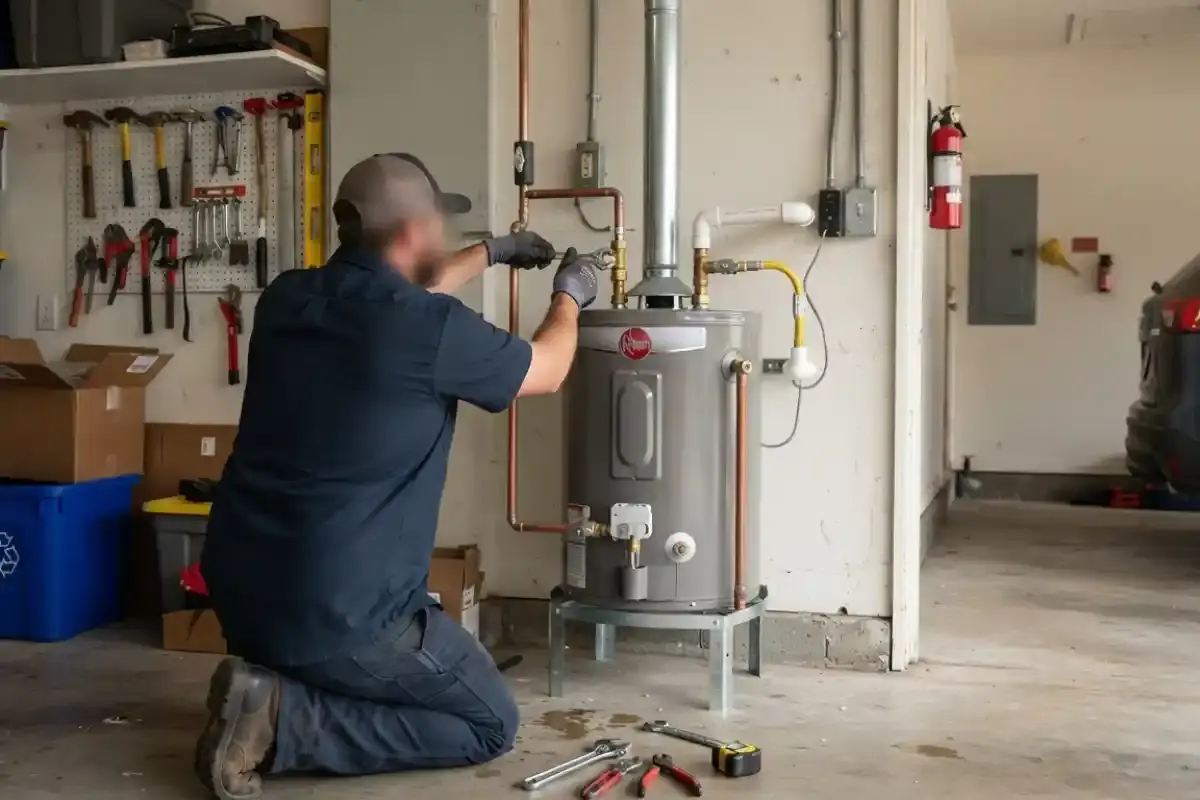
The tank is leaking or the heater is dead: do these first
A small drip can turn into a flooded garage overnight, and a failed heater can leave a household without hot water on the worst possible day. A few quick moves limit the damage while we get to you.
Cut the energy source
On an electric unit, switch off its breaker. On a gas unit, turn the gas control knob to the off position or close the gas shut-off on the supply pipe. If you smell gas, leave the building and call the gas utility or 911 before anyone calls us.
Close the cold inlet
The cold water supply valve sits on the pipe entering the top of the tank. A quarter-turn lever closes in one move, and a round handle turns clockwise until it stops. This stops new water from feeding a leak.
Find where the water is coming from
Look at the top fittings, the relief valve discharge pipe, the drain valve near the bottom and the tank body. Wet fittings are usually repairable. Water running out of the tank shell itself is a different story, and we cover it below.
Contain and photograph
Put a bucket or towels where the water lands, move stored items off the floor and take a few photos for your insurer. Do not open the drain valve to empty the tank unless we ask you to.
Water heater in a shared closet of a condo building? Let the manager or association know, because water that gets past your unit can reach neighbors below.
Reading the symptoms before anyone opens a panel
Most calls come down to a short list of problems. Here is how each one tends to show itself and what we check first.
No hot water at all
On an electric tank, a tripped breaker, a failed upper thermostat or a burned-out heating element is the usual cause. On gas, a pilot that will not stay lit or a worn thermocouple often keeps the burner from firing.
Warm but never hot
A failed lower element, a thermostat set too low, or a thick layer of sediment insulating the burner from the water can all cause it. A dip tube that has cracked can also feed cold water straight to the outlet.
Popping, rumbling or banging
Mineral and sediment at the bottom of the tank trap steam bubbles that burst under the heat. The tank needs flushing before the buildup harms an element.
Water at the top or the side
Leaks at the hot and cold connections, or at a loose nipple, can usually be tightened or replaced. They are worth fixing early because dripping water speeds up rust on the fittings.
Discharge from the relief valve pipe
The temperature and pressure relief valve opens when pressure or heat climbs too high. A steady dribble can mean a worn valve, high household pressure, or a missing expansion tank.
Inside a tank heater: the parts we test and replace
An electric heater has two heating elements, each controlled by its own thermostat, plus a high-limit cutoff that trips if the water runs too hot. We test continuity on the elements with a meter, check voltage at the terminals and look for a scorched wire or a cracked thermostat bracket.
A gas heater relies on a pilot assembly or an electronic igniter, a thermocouple or flame sensor, a gas control valve and a burner under the tank. A weak flame, soot on the burner or a pilot that blows out usually traces to a dirty orifice, a worn sensor or a draft problem in the vent.
The anode rod is the sacrificial metal inside the tank that corrodes so the steel does not. If it is mostly gone, the tank starts to rust, so checking the rod during a repair visit can add useful life to a heater that is otherwise healthy.
How we work through a no-hot-water call
We follow a set order so we fix the real fault, not just the loudest symptom.
- 1
Make the unit safe
We confirm power or gas is off, check for leaks and combustion odors, and look at the drain pan and surrounding floor.
- 2
Test before touching parts
Meters, gas pressure checks and a close look at the controls tell us whether the fault is electrical, gas related or inside the tank.
- 3
Explain the finding and the choices
You hear what failed, what it costs in broad terms to fix, and whether the heater is worth repairing. A clear price comes before the work starts.
- 4
Repair and flush if needed
We swap the failed part, drain sediment through the drain valve when the tank calls for it and refill the tank with the air purged from the hot lines.
- 5
Check the safety devices
We test the relief valve and its discharge pipe, confirm the thermostat setting and make sure the heater runs a full cycle before we leave.
Repair or replace? How we weigh it
Fixing a heater makes sense when the tank is intact. Once the shell is compromised, nothing we do from the outside will hold. Our water heater replacement page covers the tank-failure side in depth.
Repair usually makes sense
- A bad element, thermostat or igniter on an otherwise dry tank
- A weeping connection or a worn relief valve
- Noise from sediment that a flush can clear
- A first failure on a heater that has been reliable
- A rod that can be changed before the tank rusts through
Replacement is the better call
- Water seeping from the tank body or its seams
- Heavy rust at the bottom or around the drain valve
- Repeated part failures in a short span
- A repair bill that approaches the cost of a new unit
- A tank so old its parts are hard to source
Tankless units have their own parts and error codes, so those repairs are handled on our tankless water heater page.
Garages, closets and Deerfield Beach conditions that affect your heater
Many local homes and condos sit on concrete slabs with few or no basements, so heaters often live in garages, hall closets or small utility rooms. In a summer garage the air gets hot enough to stress the controls and the flue, and a closet with no airflow makes a gas unit work harder.
The City of Deerfield Beach disinfects with chloramine and publishes an annual water quality report, which does not list a hardness figure. If you suspect scale on your elements, test your tap and ask the city for its report before spending on any treatment. A flush schedule suited to your tank is more useful than guessing.
Some newer households use hybrid heat pump heaters, which move heat from the surrounding air into the tank. They add a compressor, a fan and a condensate drain to the parts list, and they need open airflow. We service the water side and controls, and we will say plainly when a fault needs the factory service channel.
What shapes the cost of a water heater repair
A new igniter and a leaking tank body are very different jobs, so we diagnose first and quote after. You get a clear price before work starts, and these are the main drivers.
Sudden water damage from a failed tank is often covered by homeowner policies, while the heater itself and gradual leaks usually are not. Check your policy, and take photos before you clean.
Permit rules vary, so ask the City of Deerfield Beach building department if your repair touches gas lines or venting. Work follows the Florida Building Code, Plumbing.
Want your real number? Call us and describe the job.
(561) 448-8545Water heater repair questions from Deerfield Beach homes
Yes. The emergency line is open 24/7, including nights, weekends and holidays, and we offer same-day appointments when available. We cannot promise an exact arrival time, since it depends on active calls and where our crews are.
Call (561) 448-8545, and we will help you shut down the heater safely while we schedule the visit.
It can be a loose drain valve, a relief valve discharging into the pan, condensation on a cool tank, or the tank itself failing. A drain valve or a fitting can be fixed. A tank that leaks from the shell cannot be patched.
If you are unsure, shut off power or gas and the cold inlet, then call us. We will tell you which type of leak you have.
A flush clears sediment that lowers efficiency and causes rumbling. How often depends on your water and how much you use, so there is no single schedule. Test your tap, ask the city for its annual water quality report, and have a plumber check the drain water.
An annual look at a tank heater is a sensible habit, especially if you hear popping.
Only if the manufacturer's label on the heater gives clear steps and you smell no gas. If the pilot will not stay lit after a careful try, a worn thermocouple or a dirty orifice is likely, and that is a repair job.
If you ever smell gas, leave the building and call the gas utility or 911 first.
The valve can wear out, the household water pressure can run high, or a heated tank can lack an expansion tank to absorb the extra volume. Plugging the valve is never an option because it is the safety device.
We test the valve and the pressure, then replace the valve or add an expansion tank if needed. Larger tank failures are covered on our replacement page.
We look at tankless problems such as error codes, scale buildup and gas or venting faults, and we explain what we find. Some repairs need parts that only the manufacturer supplies, and we will tell you so.
Details are on our tankless water heater page.
Yes, we dispatch from Deerfield Beach to nearby Broward County towns. See our Coconut Creek page for that area, or give us your street and ZIP when you call.
We confirm coverage on the phone before booking.