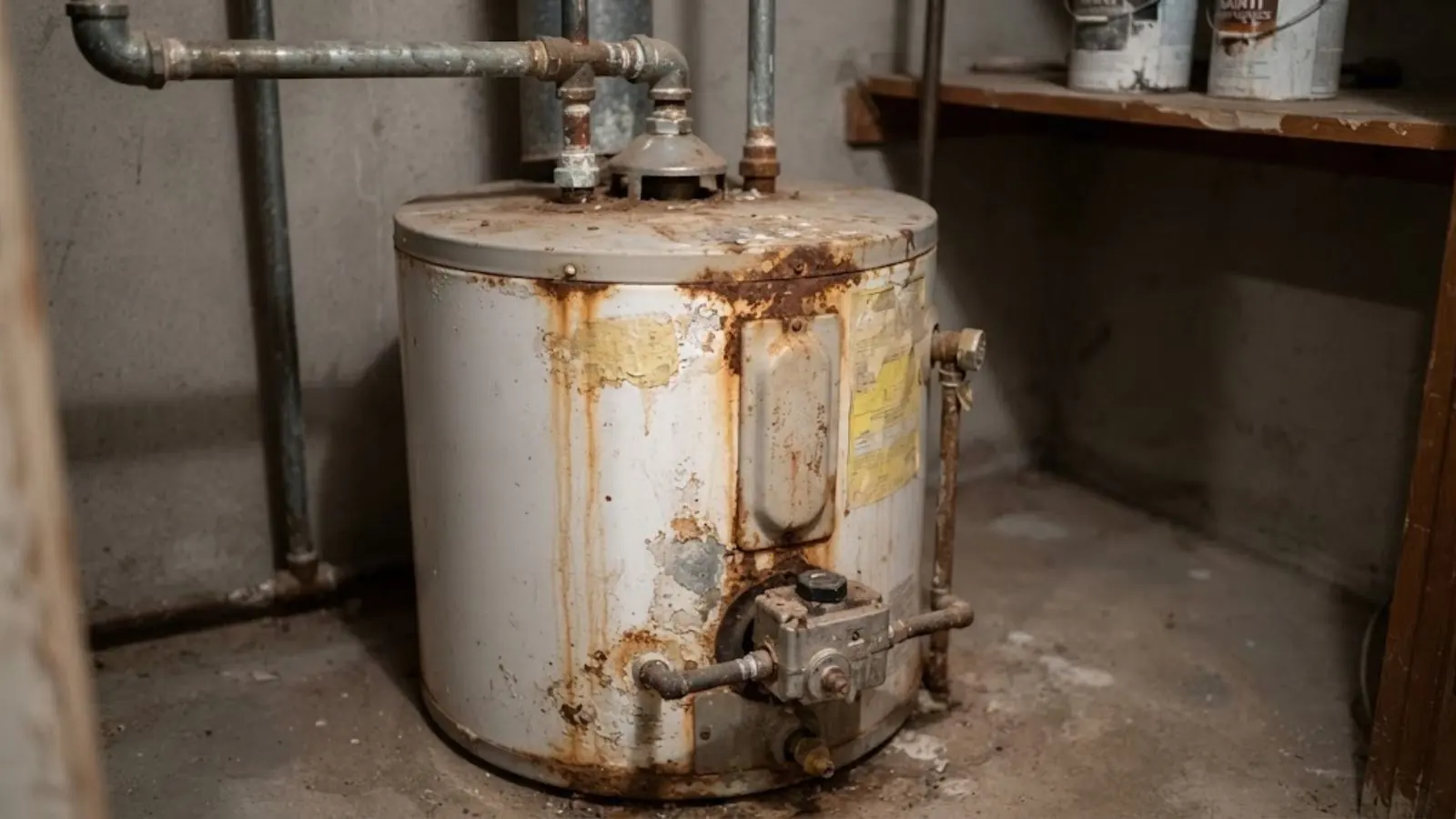
Your tank is flooding the floor
Once water is escaping through the steel shell, the tank is finished and every minute adds to the mess. Your job is to stop the supply and protect the building until we arrive.
Stop the incoming water
Close the cold inlet valve on the pipe above the tank. If that valve is stuck or leaking, close the main shut-off for the whole property, usually near the meter or where the line enters the building.
Kill power or gas
For an electric heater, flip its dedicated breaker, because a dry element can burn out and wet wiring is dangerous. For gas, turn the control to off. A gas smell means leave the building and call the gas utility or 911.
Pull belongings out of the water
Move boxes, tools and anything else stored on the garage floor. Water spreads under walls faster than most people expect on a flat slab.
Document, then wait for us
Photograph the tank, the label and the water line on the floor. Leave the tank full if you can, since we will drain it safely when we arrive.
In a condo, call your manager as well. A heater failure over a shared wall or an upstairs unit can send water to units below.
From dead tank to hot shower: the replacement sequence
A swap can finish in a single visit when the new unit fits the old connections. These are the stages we work through.
- 1
Confirm the failure
We check the leak path to make sure the tank shell is the source, not a fitting we can tighten. If a cheaper repair would hold, we say so.
- 2
Drain and disconnect
We drain the tank to a safe spot, cut the water and fuel connections, and free the vent or electrical feed.
- 3
Set the new unit
The heater goes into a fresh drain pan with a discharge line, on a level base, with new flexible connectors and shut-off valves where the old ones are tired.
- 4
Add the safety hardware
We fit a new temperature and pressure relief valve with a proper discharge pipe, and an expansion tank when the system needs one.
- 5
Fire it up and test
We fill the tank, bleed air from the hot lines, check every joint for seepage, verify the gas flame or electric elements and set the thermostat.
Picking the next heater: tank, tankless or hybrid
You are not stuck with the same type you had. A failed tank is a natural time to weigh your options.
Another storage tank
The simplest swap, usually the fastest, and it keeps your existing gas or electric hookup. Capacity matters, so match it to how many people shower back to back.
Tankless
No standing water to leak, and a smaller footprint on the wall. It may need a larger gas line, new venting or an upgraded electrical circuit, so the job grows. See our tankless water heater page for the trade-offs.
Hybrid heat pump
Pulls heat from surrounding air and uses less electricity than a standard electric tank. It needs room around it and a condensate drain, and the unit is taller and costs more up front.
Same-size direct swap versus a change
Switching between gas and electric means new lines, venting or a new circuit. We tell you what that adds before you commit.
How long a tank lasts, and when a repair is a waste
Tanks wear out because the steel liner slowly corrodes from the inside. The anode rod delays this, but once it is spent, rust works through the lining and the shell starts to weep at the seams or the bottom. A tank in that state cannot be repaired, and pushing it a few more weeks risks a full flood.
Age alone does not condemn a heater, and a well-maintained one can outlast a neglected one by years. Still, a unit that is well into its second decade, has already needed an element or valve, and now shows rust at the base is rarely worth another repair. Our water heater repair team will fix a good tank, and we will tell you plainly if yours is not one.
Corroded fittings and a tank that sweats near the bottom are early warnings. Replacing before the failure saves the floor, the drywall and the weekend.
Which failures mean a new heater
Not every wet tank is a dead tank. This table shows how we sort the common cases.
| What we see | Replace or repair | Reason |
|---|---|---|
| Water streaming from the tank seam or bottom | Replace | The liner and shell have failed and cannot be sealed |
| Dripping at the hot or cold nipples | Repair | A fitting or nipple swap often solves it |
| Relief valve discharging | Usually repair | A worn valve or high pressure is the typical cause |
| Rusty hot water with a rusted base | Often replace | Internal corrosion means the tank is near the end |
| Flood damage to controls or burner | Check, then decide | Wet gas valves and elements may not be safe to reuse |
| Electric tank dead after repeated element failures | Often replace | The tank may be sediment-clogged beyond a flush |
We explain which column you are in before you spend anything.
Storms, flooding and Deerfield Beach conditions
Hurricane season runs June through November, and a heater that sat in floodwater or lost power repeatedly may have damaged controls, burners or wiring. Do not restore power or gas to a unit that was underwater. Have us inspect it first, because a wet gas valve or a shorted element is a safety risk.
Many local homes and condos are on slabs, so a garage heater sits right at floor level where water collects. A raised stand and a drain pan with a discharge line cost little compared with a ruined garage, and we install both with every swap. The city uses chloramine and publishes an annual water quality report, so ask the city for it and test your tap if scale worries you. Planned upgrades are covered on our water heater installation page.
What changes the price of a heater replacement
Two replacements rarely look alike. We give a clear price before work starts, after we see the space, the fuel and the existing hookups.
Policies often cover sudden water damage from a ruptured tank, but usually not the heater itself or damage from slow, long-term leaks. Check your policy and file before you clean.
Permit rules vary, so ask the City of Deerfield Beach building department. Work follows the Florida Building Code, Plumbing.
Want your real number? Call us and describe the job.
(561) 448-8545Water heater replacement questions from Deerfield Beach homes
Yes. Our 24/7 line takes calls on nights, weekends and holidays, and we offer same-day appointments when available. We do not promise an exact arrival time because it depends on active calls.
Call (561) 448-8545 and we will tell you how to shut the tank down while we schedule.
Often we can, when the unit you need is available and the hookups match the old ones. A change in fuel type, venting or electrical service may add a second visit.
We say up front whether your job looks like a one-visit swap.
We drain and disconnect it, carry it out and haul it away with our own gear. You do not need to arrange disposal.
If you want to keep a part, such as the relief valve, tell us before we start.
It can be, because water near wiring and the element terminals is a shock hazard. Switch off its breaker before touching anything and keep out of standing water.
If the floor is wet around the electrical panel, stay out of the room and tell us when you call.
Size depends on how many people live in the home, how many showers run back to back and what fixtures draw hot water at once. Bigger is not always better, since you pay to keep extra water hot.
We ask about your household and match the tank, and we cover installs in more detail on our installation page.
It can make sense if you want a smaller unit and unlimited hot water, but it often needs bigger gas supply, new venting or an upgraded circuit. Condo rules can also limit the choice.
We walk through both options, and our tankless page lists the trade-offs.
Yes, we dispatch to nearby Broward County towns. Our Coconut Creek page explains how, or call with your street and ZIP.
We confirm coverage before booking.