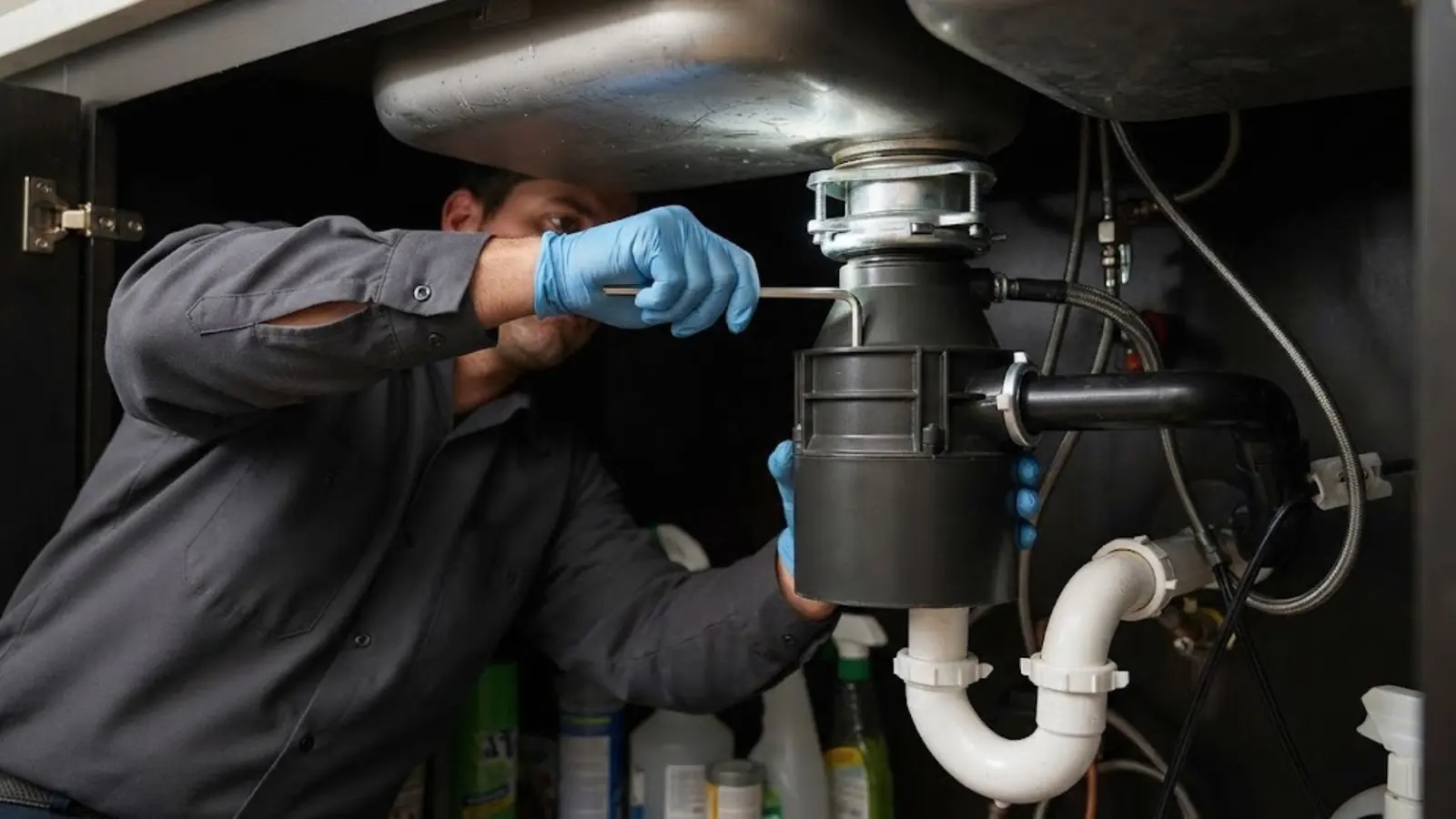
How a disposal grinds food, and why it fails
A disposal does not have blades in the way most people picture. A motor spins a steel plate fitted with small swivel lugs, and those lugs push food against a shredder ring on the chamber wall. Water carries the fine waste into the trap and the drain line.
That design is simple, so most failures come from a few places. The flywheel jams on something hard, the motor overheats and trips its thermal overload, the rubber sink flange seal dries and leaks, or the unit simply wears out after years of use. A hum with no spin means the motor has power but the flywheel is stuck.
Kitchens near the coast, around Main Beach and The Cove, add humidity and salt air to the picture. Under-sink metal parts corrode faster in that climate, which is why many leaks start at the mounting ring or a metal drain elbow.
The disposal is jammed, humming, or leaking onto the cabinet floor
Disposals combine electricity, water and a spinning plate, so the first rule is to take power out of the picture before anything else.
Switch it off at the wall and the breaker
Turn off the wall switch, then unplug the unit from the outlet under the sink if you can reach it dry. If the outlet is wet, switch off the breaker and stay out of the water.
Never reach into the chamber
Do not put a hand or a utensil into the opening. If you need to look inside, use a flashlight and a pair of long tongs only after the power is confirmed off.
Free a jam from below
Many units have a hex socket in the bottom center. A hex key worked back and forth often frees a stuck flywheel. Then press the red reset button on the bottom and try again.
Stop the leak
Close the angle stops if water is coming from the supply side, or put a bowl under the drip and run no water until we arrive. Empty the cabinet before swollen particleboard becomes a second repair.
If the hex key frees it but the unit trips again, or if smoke or a burning smell appears, stop and call. A motor that keeps overheating is nearing the end of its life.
Fix the unit you have, or install a new one
Disposals are not built to be rebuilt. Most parts are cheap, but the motor and housing are not, so the decision comes down to the failure.
Repair is the better call when
- A jam clears with the hex key and the reset button
- The unit is leaking from a loose drain or dishwasher connection
- A power cord or wall switch has failed, not the motor
- The sink flange seal needs new putty or a gasket
- The unit is fairly new and otherwise runs quietly
Replacement is the better call when
- The motor hums with no response after a hex key and reset
- The housing is cracked or leaking from the body seam
- Rust and corrosion have eaten through the casing
- The unit jams repeatedly or trips the overload every day
- The chamber is so worn that grinding no longer works
We tell you plainly which side your unit falls on. If a quick fix will do, we do not sell a new one.
Items that never belong in a disposal
Most clogs and jams trace back to what went in. These items cause trouble more than any others.
- Grease, fat and oil They cool in the trap and the line and build a coating that traps everything else, so wipe pans before rinsing.
- Coffee grounds in volume Grounds pack into a dense paste inside the trap and slow the whole kitchen line.
- Fibrous or stringy food Celery, corn husks and artichoke leaves wrap around the shredder plate and cause jams.
- Starchy, expanding food Rice, pasta and potato peel swell with water and settle into a thick paste.
- Bones, pits and shells Large hard items bounce around the chamber and can jam or damage the lugs.
- Non-food items Bottle caps, silverware and sponge scraps do not belong in the unit at all.
Run cold water before, during and for a short time after each use, and let the unit empty before you switch it off. That moves waste past the trap before it settles.
Symptoms and likely causes
The sound the unit makes, or does not make, narrows down the problem.
| Symptom | Likely cause | What we do |
|---|---|---|
| Humming, no spin | Jammed flywheel | Free it with a hex key, reset the overload and test |
| Total silence | Tripped reset, bad switch or no power | Check the outlet, switch and wiring |
| Leak from the top ring | Failed sink flange seal | Reseat the flange with fresh putty or a gasket |
| Leak from the side | Loose or cracked drain, dishwasher hose | Tighten or replace the connection |
| Leak from the bottom | Cracked housing or failed internal seal | Replace the unit |
| Slow drain with the unit running | Blockage beyond the trap | Clear the line and the trap |
A leak from the bottom of the casing almost always means replacement.
Dishwashers, slow drains and shared lines
Most dishwashers drain through the disposal, using a small hose that ties to an air gap or a high loop. If the dishwasher backs up into the sink, a plugged knockout plug on a new disposal is a common culprit, along with grease in the drain line. When the kitchen drain stays slow even after the disposal runs clean, our drain cleaning service can clear the line beyond.
Condo owners in communities like Hillsboro Cove, Crystal Lake and Century Village should ask the association whether disposal installations are allowed and whether the kitchen drain ties to a shared stack. Some buildings restrict disposals, and a grease-heavy kitchen line can clog a shared stack that affects neighbors.
For homes to the west, our Coconut Creek page explains how we reach you.
What affects the price of a disposal repair or replacement
A free-up and reset costs far less than a new unit with fresh wiring, so we describe the price factors instead of guessing. You get a clear price before work starts.
Homeowners policies often cover sudden water damage from a leaking disposal, but they usually do not pay for the unit itself. Check your policy and keep photos of the cabinet and floor.
If a slow leak ruined the cabinet base over time, coverage is less likely, so catching it early helps both the cabinet and any later claim.
Want your real number? Call us and describe the job.
(561) 448-8545Disposal questions from Deerfield Beach homeowners
Yes. Our emergency line is open 24/7, including nights, weekends and holidays, and we offer same-day appointments when available. We do not promise an exact arrival time, because it depends on active calls and crew locations.
Call (561) 448-8545, and we will tell you how to make the kitchen safe while we line up a visit.
It is a small red button on the bottom of the unit, under the sink. Switch the power off, wait a few minutes, free the flywheel with a hex key if needed, and then press the button.
If it trips again right away, the motor may be failing and it is time to call.
Only after the power is off while you work and every foreign object is out of the chamber. Turn the power back on, run cold water, and listen for smooth spinning.
If it hums, grinds hard or leaks, turn it off and call us.
The waste is not getting past the trap. A grease-coated line, a trap packed with grounds, or a blockage farther down can all cause it.
Our drain cleaning service clears the line, and if the problem recurs a camera look can show why.
Yes. The dishwasher hose connects to a port on the disposal, and a loose clamp or a blocked port can leak or back up. A new unit has a knockout plug that must be removed before the dishwasher hose is attached.
We check this connection during every install.
Usually, yes, if the sink drain, the outlet and the cabinet space allow. We confirm there is a switch or outlet, and that the trap and drain line can handle the extra waste. Our plumbing installation page explains new fixture work in general.
In a condo, confirm the association allows disposals first.