A line is backing up and cannot wait for the next shift
Jetting is a fast fix for the right clog, but the steps you take before we arrive protect the building and make the work easier.
Stop feeding the line
Turn off dishwashers, pot fillers and ice machines that drain into the blocked line, and ask staff or residents to avoid flushing. A line that is already full takes in more water and overflows at the lowest drain.
Find the cleanout
Look for a capped pipe near the building wall, in a mechanical room, or in the parking area. Do not open it if water is standing high behind the cap, but tell us where it is so we can start quickly.
Keep people and power clear
Rising floor-drain water near coolers, panels or kitchen equipment is a shock and slip hazard. Block the area, lift stock off the floor, and switch off only what you can reach safely and dry.
Note the pattern
Tell us which drains slowed first, whether grease was recently poured down, and whether the problem has happened before. That history helps us decide how aggressive the cleaning pass should be.
For a leased space in a plaza or a condo building, tell the landlord or association right away. A shared line may need their approval or their key to a common cleanout.
How the jetting visit runs, start to finish
We keep the process predictable so you know what happens to your pipe at each stage.
- 1
Size up the line
We ask what has been draining, locate the nearest cleanout, and check whether a clear path exists for the hose.
- 2
Camera first when it makes sense
If a line has failed repeatedly or we suspect damage, we run a camera before the water so we know what the jetter will face.
- 3
Feed the hose with the right nozzle
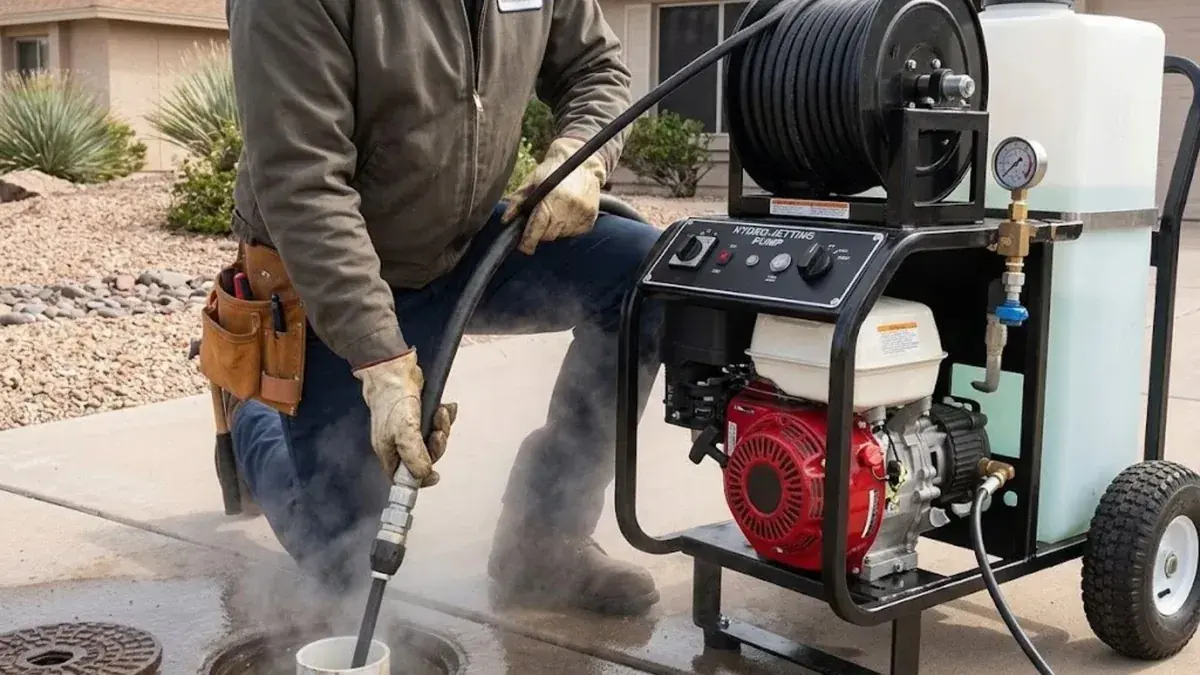
We choose a nozzle for the job. A forward-facing tip bores through a stoppage, and rear-facing jets pull the hose along while scouring the walls.
- 4
Work back out slowly
We clean on the way out as well as the way in, watching for debris returning to the cleanout and adjusting pressure to the pipe material.
- 5
Confirm flow and report
We run water through the line, check that the fixtures drain normally, and describe what we removed and what we saw.
Jobs where high-pressure water earns its keep
A hydro jetter is a specialist tool. These are the situations where it usually beats a cable on results.
Grease and scale in kitchen lines
Fat hardens into a waxy lining that a cable only pokes through. Hot, high-volume water strips the lining and restores the pipe's full diameter.
Tree roots and silt in main lines
Fine roots enter at joints and trap paper and silt behind them. A cutting nozzle clears the roots and flushes the sediment out together.
Yard drains and culvert pipes
Sand, leaves and mud wash into catch basins during heavy summer rain. Jetting pushes the buildup out of the run so the next storm drains properly.
Restaurants and food service
Grease interceptor inlets, prep sinks and floor drains see daily loading. Scheduled jetting keeps these lines open between slow periods.
Shops, offices and plazas
Shared building lines collect everything from every tenant. A periodic scouring prevents one tenant's problem from flooding another's floor.
Lines that clear, then fail again
Repeated clogs in the same spot suggest a coating or a ledge. Jetting cleans the whole run so we can see whether the pipe is sound underneath.
Restaurants and shops along W Hillsboro Blvd
Our base is on W Hillsboro Blvd, and we see how hard a food business works its drains. A busy kitchen in a plaza such as Deer Run or Shoppes at Deerfield sends fat, starch and food scraps through the same shared building line as the salon and the dry cleaner next door.
That shared line is why one tenant's slow drain can become everyone's flood. If a landlord controls the cleanout, call before the lunch rush, because a jetting visit goes faster when we can reach it right away.
For wider commercial needs such as hand sinks, floor drains and after-hours calls, our commercial plumbing service page explains how we work with property managers.
Jetter and cable machine side by side
Neither tool replaces the other. This table shows where each performs best so you can follow our recommendation.
| Condition | Cable machine | Hydro jetter |
|---|---|---|
| Soft blockage in a single fixture line | Usually enough | More than the job needs |
| Grease lining along a long run | Leaves a film behind | Strips the lining |
| Fine roots at joints | Cuts through the center | Cuts and flushes the debris out |
| Silt and sand buildup | Pushes it along | Washes it out of the pipe |
| Cracked or collapsed pipe | Stops or snags | Cannot repair damage and may worsen weak pipe |
| Tight access with no cleanout | Often easier | Needs a point to enter the line |
Jetting cleans pipe but does not rebuild it, which is why we look at the line first when the problem repeats.
Honest limits and when we camera first
Hydro jetting will not fix a collapsed pipe, a belly that holds water, or a joint that has pulled apart. In a weak clay or aged cast iron line, strong pressure can make an existing crack worse. That is why we run a sewer camera inspection before jetting whenever the history or the first look raises doubts.
If the camera shows damage, we explain what the water would have done and recommend sewer line repair instead. We would rather skip a jetting job than sell one that cannot succeed, and in lines with shared stacks, we also make sure the association knows what is planned.
What affects the price of hydro jetting
Jetting costs more than a basic cable pass because the equipment is larger and the setup takes longer. We give a clear price before work starts so the scope is settled first.
Insurance rarely pays for jetting as routine maintenance. If a backup damaged floors, drywall or stock, your policy may cover that damage, so check it and take photos before cleanup.
Businesses should ask the landlord who is responsible for the shared building line, because the lease often decides who pays.
Want your real number? Call us and describe the job.
(561) 448-8545Hydro jetting questions from Deerfield Beach property owners
Yes. Our emergency line is open 24/7, including nights, weekends and holidays, and we offer same-day appointments when available. We do not promise an exact arrival time because it depends on where our crews are and how many calls are active.
Call (561) 448-8545, and we will ask a few questions so the right equipment is on the truck.
On sound pipe, a properly set jetter is safe. On a cracked, thin or deteriorated line, strong pressure can widen the damage. That is the reason we look at the pipe first when a line is old or has a history of problems.
For grease, scale, silt and fine roots, usually yes, because water cleans the whole pipe wall. For a simple soft stoppage, a cable machine may be faster and cheaper.
Our drain cleaning page explains how we decide between the two.
It depends on volume and what goes down the drain, so we cannot give a single schedule. A kitchen with heavy fry oil and prep waste needs more frequent service than a small cafe. After the first visit we can tell you what the line looked like and suggest an interval.
It clears the roots in the pipe, but it does not remove the tree or seal the joint they entered through. Roots can return, so we may suggest periodic jetting or a repair at the joint, depending on what the camera shows.
Yes, when we can reach the line from a catch basin or open end. Heavy summer rain washes sand and leaves into these pipes, and a flush before the wet season helps them keep up. Ask about it when you call (561) 448-8545.
We serve nearby Broward County towns. Our Coconut Creek page explains how we work there, and our service areas page lists the rest. Give us your street and ZIP so we can confirm coverage.