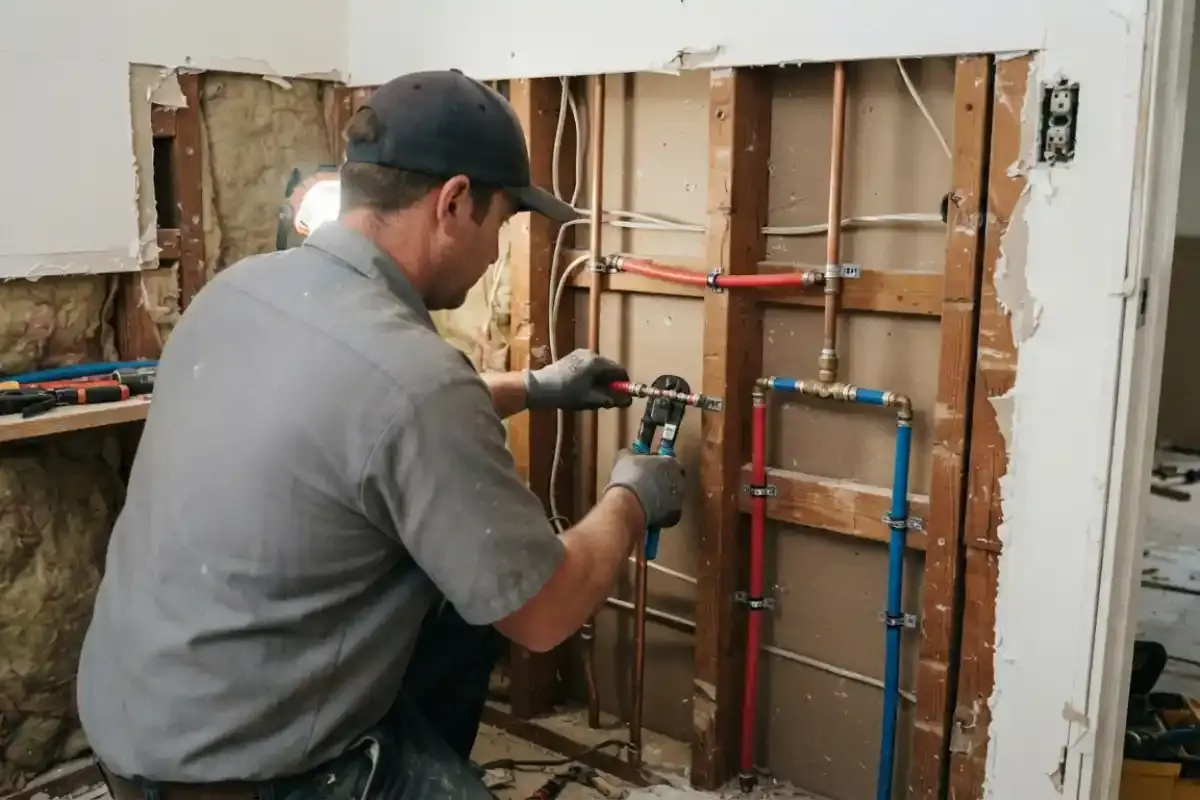
Patch it again or replace the whole system?
One leak in an otherwise healthy line is a repair, plain and simple. We cut out the bad section, splice in new pipe and test the result. Nothing about that calls for tearing into every wall in the house.
The picture changes when leaks start showing up in different rooms, or when the same run fails twice within a short stretch. Pipe wears from the inside as well as the outside, so a pinhole in one spot usually says the wall thickness is thin everywhere along that line. Each patch buys time, but you also pay for a new visit, a new hole in the drywall and a new round of drying.
A good rule of thumb is to ask what the next failure will cost, not just this one. If the honest answer is another opening in a finished wall, repiping starts to look reasonable. If the rest of the system tests sound, we will say so and keep the repair small.
Five signs the pipes are wearing out
No single symptom proves a house needs new pipes. Together, these are the ones that make us recommend a closer look.
Leaks that keep moving
A fix in the hall bath is followed by a stain in the kitchen a few months later. Repeated failures at different points are the strongest sign of a tired system.
Pinhole sprays and green crust
Tiny pinholes in metal pipe, or a green and white crust on fittings, point to corrosion eating through the wall of the pipe. Homes near Main Beach and The Cove also deal with salt air working on exposed metal.
Brown or rusty water
If the water runs the color of weak tea after sitting overnight, steel pipe may be shedding rust inside. A quick run of the tap that clears it only hides the cause.
Pressure that fades
Mineral and rust buildup narrows the inside of older pipe. You may notice the shower weakening while the neighbor's seems fine, and a plumber can confirm the cause with a pressure gauge before anyone suggests replacement.
Water bills that creep up
A slow leak in a wall adds to the bill month after month. Our leak detection service can confirm whether water is escaping before you decide on a bigger project.
How a whole-house repipe works, start to finish
The goal is a new supply system with as few openings in your walls as the layout allows. Here is the order we follow.
- 1
Walk the house and map the lines
We find the main shut-off, trace the routes to each bath, kitchen and appliance, and note where pipes run through walls, attic space and the slab. This map decides how many openings the job needs.
- 2
Agree on materials and scope
You see the options in plain terms, along with what each means for your home. We confirm whether the water heater connections and shut-off valves are part of the work.
- 3
Plan the water shutoff and the access points
Where we can, we run new lines through attic space, garage ceilings and closets rather than finished walls. Small, planned openings are easier to patch than scattered surprise holes.
- 4
Install the new lines
We run the new supply pipe to every fixture, connect it to the main and the water heater, and install new valves at the fixtures where needed. The old lines are shut off and abandoned or removed depending on access.
- 5
Pressure test and flush
The new system is filled, pressure tested and checked for leaks at every joint. We flush the lines so debris does not reach your faucets. Work follows the Florida Building Code, Plumbing, and permit questions go to the City of Deerfield Beach building department.
Copper, PEX and CPVC side by side
Each material has real strengths and real downsides. There is no universal winner, and the right choice depends on your house, your budget and how the pipe will be routed.
| Material | Where it shines | Watch out for |
|---|---|---|
| Copper | Long track record, handles heat, stands up to sunlight and is fully recyclable | Heavier labor, more joints to solder, and it can corrode in some water or from outside salt exposure |
| PEX | Flexible tubing, fewer joints, fast to route through tight attic and wall spaces | Sunlight damages it, so it must stay covered outdoors, and rodents or sharp edges can nick it |
| CPVC | Rigid, lightweight, simple to cut and glue, resists many forms of corrosion | Can turn brittle with age and heat, and it needs support at the right intervals |
| Galvanized steel (existing) | Still in service in some older buildings | Rusts from the inside, narrows over time and is the usual reason for a replacement |
Ask us to explain why a material fits your layout, and expect an honest answer if two options would work equally well.
Old galvanized lines, and what living through the work is like
Galvanized steel pipe is the classic repipe candidate. The zinc coating wears away, rust builds up inside and the opening shrinks until pressure falls and the water picks up color. Replacing it rarely makes sense one fixture at a time, because the leftover old pipe keeps clogging whatever you add.
Many Deerfield Beach homes and condos sit on concrete slabs with few or no basements, so supply lines usually run through walls and overhead spaces, and sometimes under the floor. We check which lines are accessible from above before we plan. In a slab home with a leak already under the floor, our slab leak repair service looks at spot repair and rerouting before a full repipe is on the table.
As for the disruption, expect the water to be off for part of each working day. Plan for showers and cooking elsewhere, cover or move furniture near the work, and keep pets away from open walls. We schedule the shutoffs so the water is back on before evening whenever the job allows, and we explain the routine before the first day starts.
Condo units, shared risers and the building's rules
Repiping in a condo is a coordination job as much as a plumbing job. In communities such as Century Village, Hillsboro Cove and Crystal Lake, shared risers and stacks often fall under association rules, and the building may need to shut water off for several units at once. Ask your manager or association about approvals, work hours and any required notice before we set a date.
If several neighbors have the same trouble, a joint plan can save everyone repeated shutoffs. We are glad to talk with a property manager, and for emergencies such as a sudden break, our burst pipe repair service gets the water stopped first.
What drives the price of a repipe
Repiping prices vary widely from house to house, so a number given without seeing the building is a guess. We walk the lines, then give a clear price before work starts. These are the factors that move it.
Homeowner policies often cover the sudden water damage a leak causes, but they usually do not pay to replace worn pipe or to cover gradual leaks. Check your policy, and call your insurer before any major job if a claim is in play.
A licensed contractor matters here. You can verify a plumber's state license through the Florida Department of Business and Professional Regulation online services, and under Fla. Stat. 489.128 an unlicensed contractor cannot enforce its contract.
Want your real number? Call us and describe the job.
(561) 448-8545Repiping questions we hear in Deerfield Beach
Look at the pattern. A single failure with sound pipe around it is a repair. Leaks that keep appearing in different spots, discolored water and falling pressure point toward replacement.
We test the pressure and look at the pipe before recommending anything, and we will tell you if a repair will hold.
It depends on the size of the house, the number of fixtures and how easy the lines are to reach. A small condo is a shorter job than a two-story home with a finished slab.
We give you a realistic schedule after we walk the house, and we plan the water shutoffs around your day.
We try to keep openings small by running new lines through attic space, garage ceilings and closets where the layout allows. Some walls still need access, especially behind showers and in older homes.
We show you the planned access points before we start. If a leak is already under the slab, leak detection can narrow the location first.
Copper, PEX and CPVC all work well when installed correctly. Copper resists sunlight and heat, PEX is flexible and quick to route, and CPVC is lightweight and easy to cut.
We choose based on your layout, any outdoor exposure and your budget, and we explain the trade-offs rather than pushing one product.
Most families can, with some planning. The water will be off for part of the day, so set up a way to cook, wash and use the bathroom elsewhere on those days.
People with young children, medical needs or home offices sometimes arrange a short stay away. Tell us your situation and we will plan around it.
It can be, especially when leaks have shown up in more than one unit. Because shared lines belong to the association in many buildings, start by asking the association what is already planned.
Our Coconut Creek page explains how we serve condo and multi-unit properties in nearby towns, and the same approach applies in Deerfield Beach.
Policies often cover sudden and accidental water damage but usually not the cost of replacing worn pipe or gradual leaks. Some owners are surprised to learn that the repair itself is excluded even when the damage is covered.
Read your policy, document everything with photos, and call your insurer before work begins.