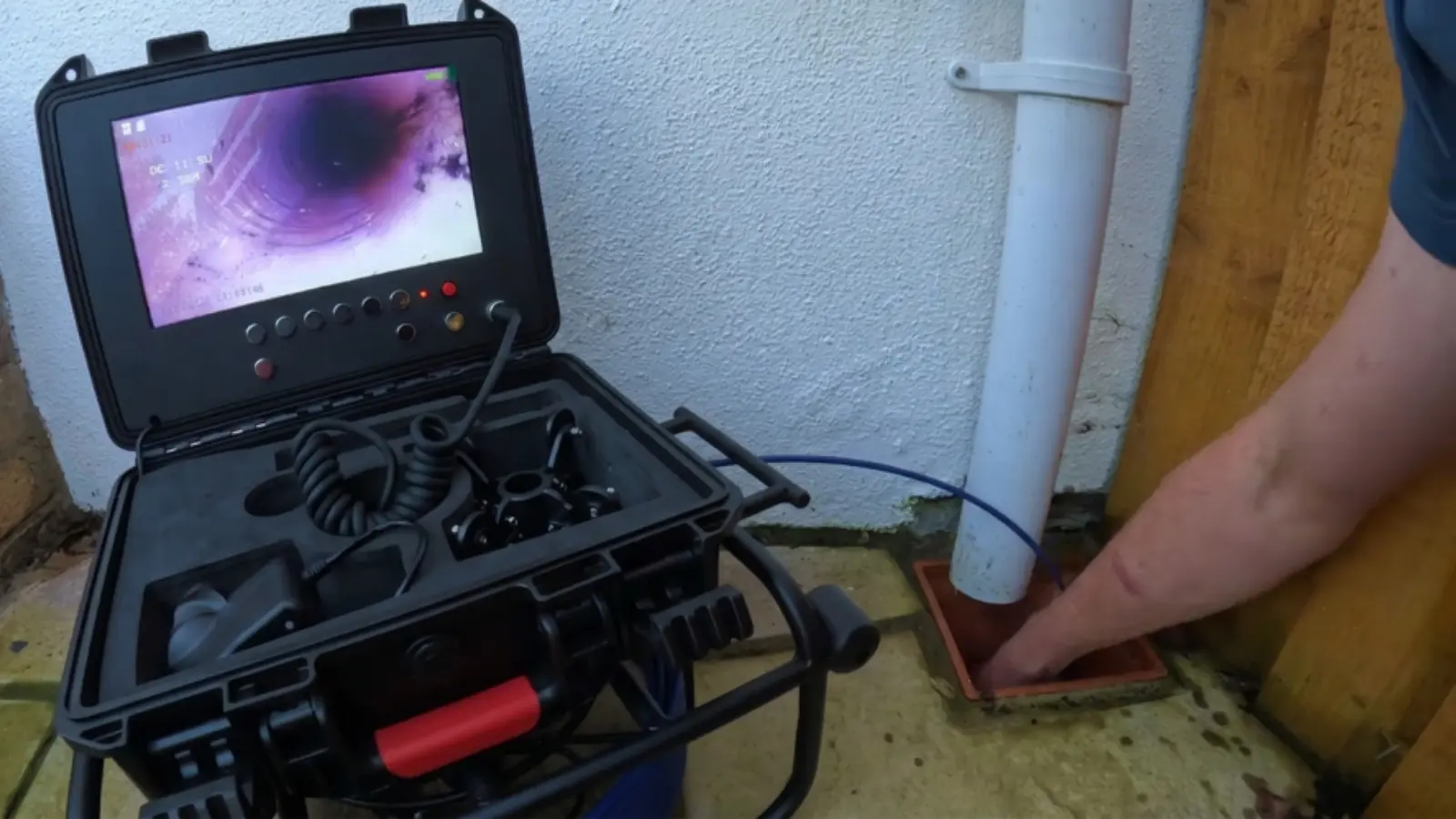
On site with the camera
The camera head has a light and a lens, and it travels on a push rod that the technician feeds into the line through a cleanout. A monitor shows the live picture, and the system records the run. The distance counter tells us how far the camera has traveled, so each defect gets a location.
Locating tools finish the job. A small transmitter in the camera head sends a signal that a hand-held receiver can track from above ground. That tells us where the pipe runs, how deep it sits and where to mark the ground if a repair is needed.
Our sewer camera inspection service uses this method on residential and light commercial lines. We do not dig on the strength of a hunch. We look first, and then we talk about what, if anything, needs to happen.
Most of the visit is calm and unglamorous. The technician sets up at the cleanout, feeds the rod steadily and stops whenever something unusual appears on screen. Taking time at each suspect spot is what separates a useful recording from a quick pass down the pipe.
From the first call to the finished report
The process is short, and each step has a purpose.
- 1
Find the access point
We look for a cleanout outside the building. If there is none, we may use a roof vent, a removed toilet or another access.
- 2
Clear the line if needed
A line packed with grease or paper blocks the lens. If so, we clear it first so the camera can see the pipe walls.
- 3
Run the camera and record
The camera moves through the line while we watch the monitor and note each defect and its distance.
- 4
Locate and mark
Using locating tools, we trace the camera from above ground and mark any spot where a repair might be needed.
- 5
Review the findings together
You see the video, hear the options and receive the written summary.
When a camera inspection earns its cost
Not every plumbing problem needs a camera. These situations are where it helps most.
Buying a home or condo
A standard home inspection does not look inside the buried drain line. A camera can find a cracked or root-filled pipe before closing, when you still have room to negotiate.
Repeated backups
A line that clogs again and again usually has a reason. The camera shows whether it is roots, a belly, a bad joint or a collapsed section.
After a repair
A follow-up run proves the new work is sound and that nothing else is failing nearby.
Before a remodel or addition
If you are adding a bathroom or building over the line, you should know its condition and route first.
Slow drains with a sewer smell
A p-trap that will not hold water, a sewer odor or several slow drains can point to a venting or line problem that a camera helps narrow.
Reading the report: what the video shows
The footage shows the pipe material, its general condition and any defects. Roots appear as fine hair-like threads or thick masses entering at joints. A crack shows as a dark line, an offset joint as a step in the pipe wall and a belly as a section holding standing water.
A good report names each finding, gives its distance from the entry point and says how serious it is. It separates problems that need action from those you can monitor. Ask for a copy of the video, since it helps with insurance conversations, negotiations and any later repair.
If the camera finds damage, our sewer line repair page explains the repair options. The recording keeps everyone talking about the same pipe.
Keep in mind that a clean report is a snapshot, not a promise. Roots can grow back, and a pipe in good shape today can shift later, so a line with a history of trouble may be worth checking again after a repair or a few seasons of heavy use.
Buying a home or condo in Deerfield Beach
If you are buying, ask whether the seller will allow a sewer camera inspection during your due diligence period. A recording of the line can support a request for repair or a price adjustment. In a condo, ask the association which lines are yours and which are shared, since the camera only helps for the pipe you are responsible for.
Before you hire anyone, verify their state license through the Florida Department of Business and Professional Regulation online services. Under Fla. Stat. 489.128, an unlicensed contractor cannot enforce its contract, which can leave you without recourse. It is a simple check that protects your money.
Many Deerfield Beach homes and condos are built on concrete slabs, so lines often run under floors and driveways. That makes a camera inspection even more useful before any digging. We also serve nearby towns, including the area on our Coconut Creek page, and you can see where else we work on our service areas page.
What a camera can show and what it cannot
A camera inspection is a strong tool with real limits. Knowing them avoids false confidence.
What it can show
- Roots, cracks and offset joints inside the pipe
- Belly sections that hold water
- Buildup such as grease and scale
- The distance and approximate depth of a defect
- The path of the line when paired with locating tools
What it cannot do
- See past a full blockage without clearing it first
- Confirm leaks in pressurized water supply lines
- Prove a pipe will never fail in the future
- Reach lines with no workable access point
- Replace a plumber's judgment about repair options
If you suspect a leak behind walls or under a slab, that is a different test. Our leak detection service uses acoustic listening, thermal imaging and pressure testing for supply lines.
How to get the most from an inspection
A few habits make the visit more useful and the report easier to trust.
- Tell us the history Share past backups, repairs and which fixtures act up.
- Point out the cleanout If you know where it is, show us. If not, we will find one.
- Ask for the video A recording is better than a verbal summary.
- Get findings in writing The report should list each defect and its distance.
- Ask about priorities Not every finding needs action now, so ask what is urgent.
- Verify the plumber Check any contractor's state license through DBPR before hiring.
Camera inspection questions from Deerfield Beach buyers and owners
Most inspections are short when access is easy and the line is clear. A packed line, a hard-to-find cleanout or a long run adds time. We explain what to expect when you call (561) 448-8545.
No. The camera head is designed for drain lines and moves on a flexible rod. A pipe already cracked or collapsed may show its weakness, but the camera reveals the damage and does not cause it.
It is a good idea, especially for a house with large trees, repeated backups in the history or an unknown line. A standard home inspection does not look inside the buried drain, so the camera fills that gap.
We go over the video, explain how serious it is and outline the repair options, from spot repair to lining to replacement. You decide what happens next. See our sewer line repair page for the options.
No. A drain camera looks inside drain and sewer lines. Pressurized supply leaks need different methods, and our leak detection service covers them.
We look outside first, along the foundation and near the point where the line leaves the building. If no cleanout shows, we may use a roof vent, a removed toilet or a floor drain as the access point. Locating tools can then trace the line from above ground so we can mark it, and we may recommend installing a proper cleanout so future service is easier.