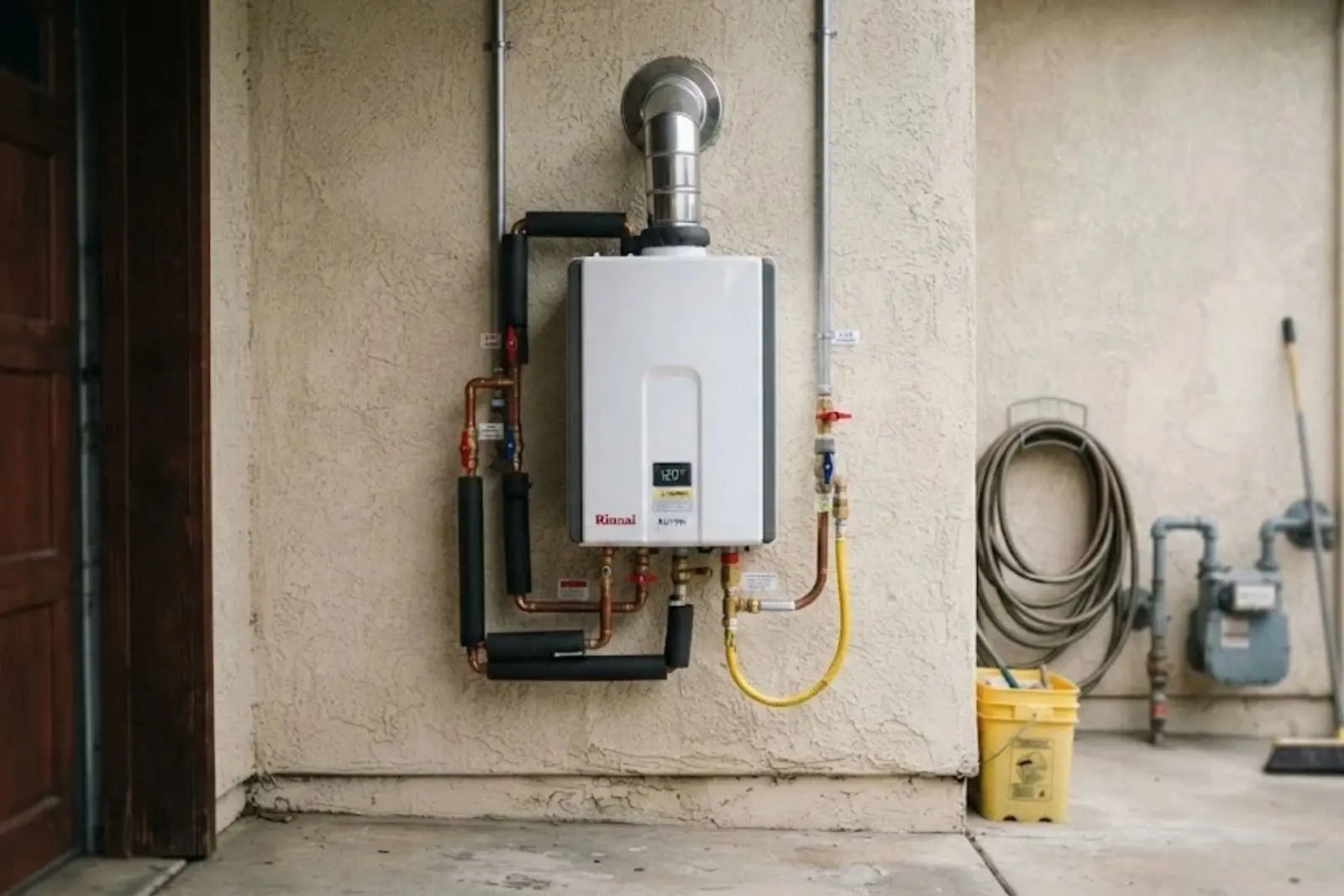
How a tankless heater makes hot water on demand
When a tap opens, a flow sensor tells the unit to fire. On a gas model, a burner heats a heat exchanger. On an electric model, powerful elements do the job. Water leaves the unit at the set temperature for as long as the flow lasts, so a long shower does not drain a tank.
The trade-off is a limit on how much hot water the unit can make at once. Run two showers and a dishwasher together and a small unit may deliver lukewarm water. Choosing the right capacity is the main task in any tankless job.
Tankless units also lose almost nothing while idle, and the compact body mounts on a wall in a garage, utility room or exterior spot. That frees floor space in slab homes where a bulky tank would otherwise take a corner of the garage.
Sizing a tankless unit by flow
Capacity is measured in gallons per minute at a given temperature rise. This is the logic we follow.
- 1
List your busiest hot water moment
Count the fixtures that might run together, such as two showers, a kitchen tap and a washer, and add their flow rates.
- 2
Find the temperature rise
That is the gap between incoming water and the temperature you want. South Florida groundwater is warm, so the rise may be smaller than in colder places, though the exact figure depends on the season and your supply.
- 3
Match flow to capacity
A unit delivers fewer gallons per minute as the rise grows. We pick one that meets your peak demand with some margin.
- 4
Consider two units
For large homes or distant bathrooms, two smaller units or a unit plus a small point-of-use heater may serve better than one giant machine.
What installation involves beyond the heater itself
A tankless swap is rarely a plug-in job. These items often turn up on the scope.
Gas supply upgrade
A gas tankless burner draws more fuel than a tank burner. The line may need a larger diameter, and the meter must support it.
Venting
Gas units need a vent sized and routed for the model, often with sealed joints and a termination clear of windows. Outdoor models skip the flue run but need a spot that suits them.
Electrical capacity
Electric tankless units pull very heavy current. Your panel and wiring may need to be upgraded, and an electrician may join the job.
Isolation valves
Service valves on the inlet and outlet let us flush the exchanger without cutting into the pipes, and they make later maintenance easier.
Condensate and drain
High-efficiency gas models produce acidic condensate that must drain safely, and a relief discharge needs a safe path.
Recirculation
A return line or small pump can cut the wait at distant taps. It adds parts and some energy use.
Safety guidance for gas tankless heaters
Gas appliances deserve a few ground rules, whether the unit is new or years old.
- If you smell gas, leave first Do not touch switches or use a phone inside. Go outside, then call the gas utility or 911.
- Keep the area around the unit clear Do not store paint, cleaners or paper near the heater or its vent.
- Do not block or alter the vent Exhaust must leave the building freely, so call a professional for any change.
- Watch for error codes and odd smells Repeated codes or exhaust odors are a reason to switch the unit off and call us.
- Use a licensed pro for gas work Gas piping and venting changes belong to a licensed contractor, never a weekend project.
Gas or electric tankless
The right fuel depends on what your building already has and what you can add.
Gas tankless
- Higher flow for the money
- Needs gas line capacity and venting
- Works best for larger households
- May run during a power outage only if the model allows it
- Maintenance includes burner and exchanger checks
Electric tankless
- No flue or combustion air
- Easier in condos without gas
- Large breaker and thick wiring needed
- Lower flow, best for point-of-use or small homes
- Fewer parts to clean
A planned swap is covered on our water heater installation page, and the failed-tank path is on our replacement page.
Descaling and flushing: building a schedule that fits your water
Minerals in water leave a crust inside the heat exchanger over time. That crust slows heat transfer, wastes fuel and can trigger error codes or shutdowns. Flushing with a mild descaling solution, circulated through the unit with a small pump through the isolation valves, dissolves the buildup.
How often depends on how much mineral your water carries and how heavily you use the unit, so there is no honest one-size schedule. The City of Deerfield Beach publishes an annual water quality report, and the one we reviewed lists no hardness figure. Ask the city for its report, test your tap with a kit, and start with a yearly flush, then adjust after you see what comes out.
A unit that is never flushed may lose capacity gradually, then show an error code. Clean it early and the repair is cheap. Wait too long and the exchanger may need replacing.
The city disinfects with chloramine and, for about three weeks a year, switches to free chlorine. We are not claiming that changes your descaling schedule. We mention it so you can ask the city and weigh it with your own test results.
Error codes, condos and common repairs
Every model has its own code list, so we read your manual and the display rather than guess. Here are the faults we see most.
| Symptom | Likely cause | What we do |
|---|---|---|
| Cold water sandwich or lukewarm output | Scale, flow sensor or undersizing | Flush, test flow, check capacity |
| Ignition failure code | Gas supply, dirty igniter or blocked vent | Check supply pressure, clean, test vent |
| Overheating shutdown | Scaled exchanger or sensor fault | Descale, test sensors |
| Unit shuts off mid-shower | Flow too low to fire or a clogged inlet filter | Clean the filter and check fixtures |
| Water leak at the unit | Loose connection or failed fitting | Tighten or replace and test |
| No power to display | Breaker, board or wiring fault | Test circuit and board |
Some control boards and parts only come from the manufacturer, and we say so when that applies. Faults we can handle are covered by our water heater repair team.
Condo owners should check association rules before ordering a tankless unit. Gas line changes, exterior venting and wall mounting often need written approval, and the Century Village, Hillsboro Cove and Crystal Lake communities may each have their own policies.
Why tankless quotes vary so much
The heater is only one line in the estimate. We give a clear price before work starts, once we see your gas, venting and panel.
A planned tankless upgrade is usually not an insured event. Sudden leaks and flooding from a failed old tank may be covered, but the new unit usually is not, so check your policy.
Keep the model and serial information. It helps with future service and with any manufacturer coverage you hold.
Want your real number? Call us and describe the job.
(561) 448-8545Tankless water heater questions from Deerfield Beach homes
It can, especially an electric unit where gas is not available, but it depends on the association and your electrical capacity. Ask for the rules in writing first.
We look at the panel, the wall space and the venting options before recommending one.
Lifespan depends on the model, usage and maintenance. Regular flushing and clean inlet filters help units reach their potential.
We do not guess at years, since results vary with water and use.
Codes point to a symptom such as a flame, sensor, flow or venting fault, and a fix depends on what caused it. Scale and blocked filters are common.
Note the code, switch the unit off if you smell gas, and call us.
Test your tap, ask the city for its annual water quality report and start with a yearly flush. If the water coming out looks cloudy, shorten the interval.
A plumber can check the water that drains out and tell you.
The plumbing and gas work are not forgiving, and venting mistakes are dangerous. Permits and code rules also apply, so hire a licensed pro.
You can verify a plumber's state license on the DBPR website, and work follows the Florida Building Code, Plumbing.
Only if it is sized for that flow. We add up the fixtures and may recommend a larger model or two units.
The installation page explains how location affects the choice.
Yes, we dispatch to nearby Broward County towns. See our Coconut Creek page or call with your street and ZIP.
We confirm coverage before booking.