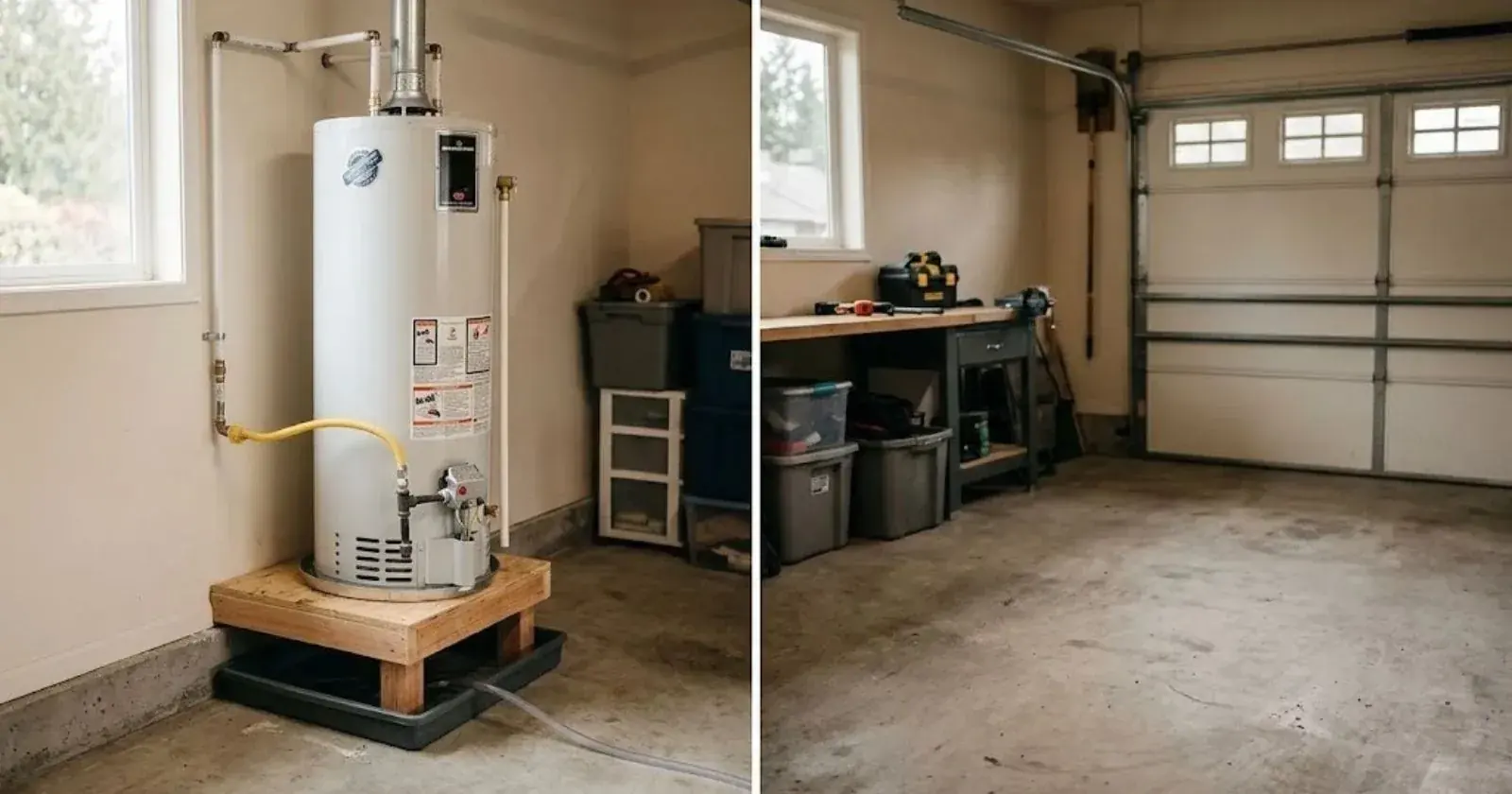
Why a planned install beats a panic swap
When a heater dies at night, you take whatever fits. When you plan ahead, you can compare fuel types, check the room where the unit will live and fix problems the old setup hid. A rusted shut-off valve, a pan that never drained or a relief pipe that ends at nothing are easy to correct on a calm Tuesday.
Planned work also lets us confirm your household load. A family with two bathrooms in use every morning needs different capacity than a couple in a one-bath condo. We ask about showers, tubs, dishwashers and laundry, then recommend a tank size, or a hybrid or tankless option when it fits.
Many local homes and condos are built on slabs, so the heater usually sits in a garage, closet or utility room rather than a basement. That choice shapes everything from drain routing to vent paths, and it is the first thing we look at on a site visit.
Decisions to settle before the heater arrives
Each of these affects the quote and the schedule, so we go through them together.
Gas or electric
Gas units need a gas line, a vent path and combustion air. Electric units need a dedicated circuit sized for the elements. Switching from one to the other adds work, so confirm what your building can support first.
Capacity and recovery
Tank size covers peak demand, and recovery rate decides how fast it refills. A larger tank with slow recovery may still run out for a busy household.
Where it will sit
Garages, closets and utility rooms each bring clearance, airflow and access questions. A heater boxed into a tight closet is hard to service and may run hotter than it should.
Drain pan and discharge pipe
A pan under the tank catches slow leaks, and a pipe from the relief valve carries hot discharge safely to a drain or outdoors. Both belong on every install.
Expansion tank
In a closed system, heated water has nowhere to go, so pressure spikes. A small expansion tank absorbs the swing and protects the tank and fixtures.
Hybrid heat pump option
It saves energy by pulling heat from room air, but needs open space for airflow and a condensate line. It works best in a roomy garage and is a poor fit for a tight closet.
An installation day, step by step
The order matters because the water, the fuel and the safety hardware all have to be right at the end.
- 1
Walk the site
We check the space, the existing lines, the venting or electrical feed and any access limits, then agree on the plan.
- 2
Shut down and remove
We turn off water and fuel, drain the old tank and take it out, repairing or replacing worn valves and flex connectors as needed.
- 3
Set and connect
The new unit goes on a level base in a drain pan. We connect water lines, the fuel supply or electrical circuit, and the vent if the heater is gas.
- 4
Install safety hardware
We fit the relief valve with a discharge pipe, add an expansion tank where needed, and set the thermostat.
- 5
Test and walk you through
We fill the tank, purge air, check for leaks, confirm combustion or element operation and show you the shut-offs and controls.
Gas, electric and hybrid at a glance
No option wins everywhere. This table shows how they differ on points that matter in a Florida home.
| Type | Strength | Watch for |
|---|---|---|
| Gas storage tank | Fast recovery, works through power loss | Needs venting, combustion air and a gas supply |
| Electric storage tank | Simple setup, no flue | Needs a dedicated circuit and a slower refill |
| Hybrid heat pump | Uses far less electricity than a standard tank | Needs air space, a condensate drain and a higher purchase cost |
| Tankless gas | Compact, endless hot water | Gas line size and venting may need upgrades |
| Tankless electric | No flue, small footprint | Large electrical demand may exceed the panel |
Our tankless page goes deeper on that choice.
Venting, combustion air and the electrical side
A gas heater needs to burn cleanly and push exhaust outdoors. That means the vent must slope, stay sealed at the joints and match the unit, and the room needs air to feed the burner. A tight closet with a louvered door is better than a sealed one, and we check clearances before we set the unit.
Electric heaters draw a lot of power, so the circuit, the wire gauge and the breaker must be matched to the elements. If your panel is crowded, an electrician may need to add capacity, and we will tell you when to bring one in. Gas work and wiring beyond the heater's own connection may be separate specialties.
Permit rules vary, so ask the City of Deerfield Beach building department what your install needs. We follow the Florida Building Code, Plumbing, and we will explain what our part covers.
Condo and HOA approval, and the salt air
In condo communities such as Century Village, Hillsboro Cove and Crystal Lake, a heater swap may need written approval, particularly if it changes fuel, touches a shared line or sits on a shared wall. Ask the association for its rules before you order a unit, because a denied plan after purchase is expensive.
Homes near Main Beach and The Cove deal with salt air, which speeds up corrosion on exposed fittings and vent hardware. We use corrosion-resistant connectors where we can and recommend a pan with a discharge line so any leak runs out instead of rotting the floor. The city also publishes a water quality report that mentions chloramine, so ask for it if you wonder how your water treats a tank.
What drives the price of a new heater
A like-for-like tank swap sits at one end and a fuel change or hybrid install at the other. We give a clear price before work starts, after we look at the space.
Planned installs are usually not covered by insurance, since no sudden damage occurred. If your old tank failed and flooded the space, a claim may cover the water damage but usually not the heater itself.
Check your policy, and keep the invoice and photos of the old unit.
Want your real number? Call us and describe the job.
(561) 448-8545Questions about installing a water heater in Deerfield Beach
Count the people, the bathrooms and the fixtures likely to run at the same time. Peak morning demand matters more than daily use.
We ask about showers, tubs, dishwashers and laundry, then match a tank or tankless unit to that load.
Often yes, but moving it changes water lines, drain routes, vent paths and electrical or gas feeds. Clearances and access matter too.
We look at the new location on a site visit and tell you what the move adds.
If your plumbing is a closed system, for example with a backflow device or a pressure regulator, heated water has nowhere to expand and pressure rises. An expansion tank absorbs that swing.
We check your system and install one where it is needed.
Many do, especially if the work changes fuel type, touches a shared line or modifies a common wall. Ask for the rules in writing before ordering equipment.
We can describe the planned work so you can send it to the board.
It can be, because it needs open airflow and a drain for condensate, and a garage often provides both. It is a poor choice for a small enclosed closet.
We look at the space before recommending one.
Yes, and the urgent path is on our water heater replacement page. If the old unit is only acting up, a repair may make sense, which our repair team can check.
Call (561) 448-8545 to talk through either.
Yes, we dispatch to nearby Broward County towns. Our Coconut Creek page has the details.
Give us your street and ZIP and we will confirm.