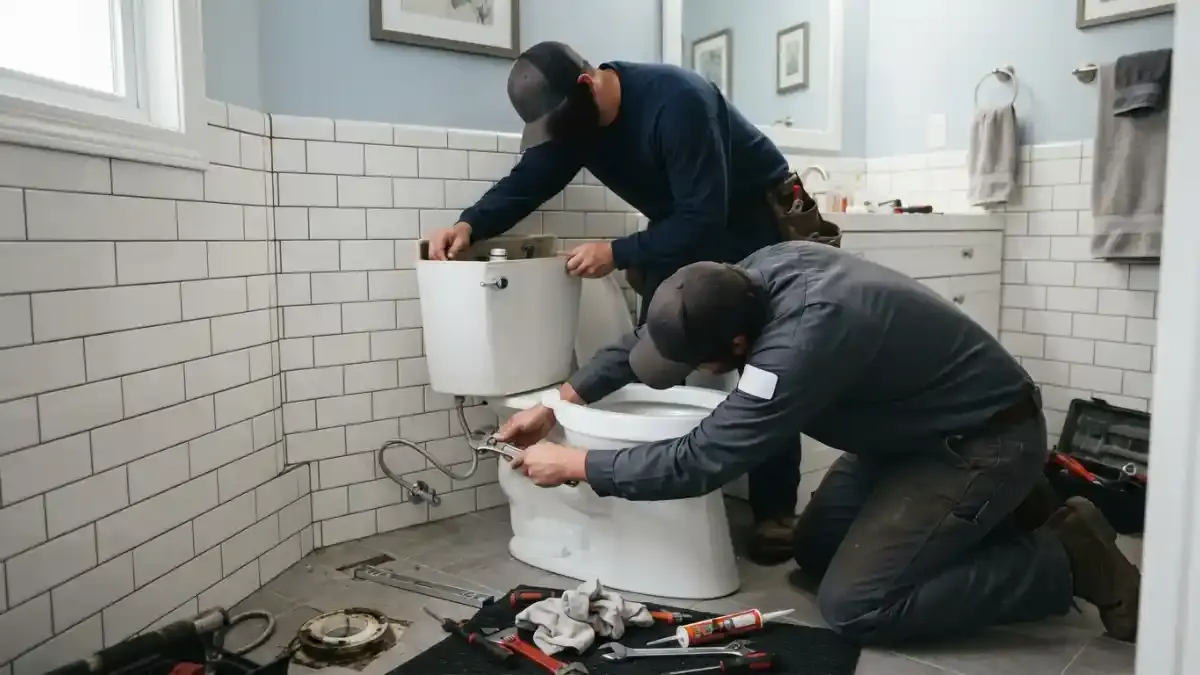
The bowl is rising toward the rim or water is on the floor
A toilet that is about to spill gives you a short window to act. The steps below stop the flow in most cases without a single tool, and they matter even more in a condo where water drops to the unit below.
Close the supply valve at the wall
Look behind or beside the base for a small oval or round handle on a thin pipe. Turn it clockwise until it stops. This cuts the refill, so the tank cannot keep feeding an overflowing bowl.
Lift the tank lid and stop the fill
If the supply valve is stuck, raise the float or the rod attached to the fill valve by hand. The water stops entering the tank while you sort out the valve.
Do not flush again
Each extra flush sends more water into a bowl that is already blocked. Wait until the level drops on its own, and leave the plunger for after the water is under control.
Contain and photograph
Lay towels along the base and the doorway, pull rugs out of the room, and take a few photos of any water that reached the floor. If a ceiling below is wet, tell the unit owner or the property manager at once.
Water coming up in a shower or tub as well as the toilet points to something deeper than the bowl. Say so on the phone, because that pattern often means a shared or main line problem and sends us down a different path.
Which part is failing decides the whole repair
A toilet looks like one object, but it is really a handful of small parts working together. The fill valve refills the tank, the flapper seals the drain opening at the bottom of the tank, the overflow tube protects against spills, and the flush lever and chain link your hand to the flapper. Underneath, a wax ring or a rubber gasket seals the bowl outlet to the closet flange in the floor.
Most trouble comes from those few parts. A flapper that has warped lets water trickle into the bowl, a fill valve that sticks keeps the tank running, and a wax ring that has lost its seal lets water creep out at the base. Knowing which one is at fault saves you from replacing a whole toilet that only needed a small fix.
Many Deerfield Beach homes and condos sit on concrete slabs, so there is no crawlspace or basement to catch a slow base leak. Water that seeps from under a toilet soaks the subfloor and the flooring edge first, and you may see it only as lifting tile grout or a soft spot.
Common toilet problems and what causes them
Most calls fall into a short list of problems. Here are the ones we see and the usual cause of each.
Running toilet, flapper or fill valve
If the tank hisses or refills on its own, the flapper may not be sealing or the fill valve may not be shutting off. We replace the worn part and reset the water level so it stops below the overflow tube.
Leaking at the base
Water around the bottom usually means a failed wax ring or a cracked flange. We pull the toilet, inspect the flange, reseat the bowl on a new seal and check that it sits level.
Loose or rocking bowl
A bowl that shifts when you sit is a warning. The closet bolts may be loose, the flange may be broken, or the floor may have softened, and a rocking toilet will eventually break its seal.
Clogged toilet and repeat backups
A single clog usually clears with a closet auger. Repeated clogs, gurgling, or several fixtures backing up together can mean a vent or drain problem, and our sewer line cleaning service handles the main line side.
Broken flush handle
A snapped handle or a chain that has come loose leaves the flapper without a lift. This is among the quickest repairs we do, and a good place to check the flapper at the same time.
Leaking supply line or shut-off valve
Drips from the braided line, or from the valve stem when you turn it, can ruin a cabinet or wall. Old stop valves often fail when finally turned, so we replace them with a quarter-turn type that closes fully.
Repair or replace: how we decide
A toilet has no set lifespan, so the decision rests on what is wrong and what it would take to fix it. This is how we weigh it.
| Condition | Usual choice | Reasoning |
|---|---|---|
| Worn flapper, chain or fill valve | Repair | Cheap parts, and the bowl and tank are still sound |
| Failed wax ring, sound porcelain | Reset with new seal | The toilet is fine, only the seal underneath gave out |
| Cracked tank or bowl | Replace | A crack in porcelain cannot be sealed in a way that lasts |
| Constant clogs from a weak flush | Often replace | Some older designs never clear well, no matter how often you snake them |
| Rusted or stripped closet bolts | Repair first | Fresh bolts and a flange repair ring often solve it |
| Rocking on a damaged floor | Repair the floor, then reset | A new toilet on a soft floor will loosen again |
Ask for the reason behind any replace suggestion, since many toilet problems are small and fixable.
Visit walkthrough, from first look to final flush
A typical visit follows the same order, whether the job is a quick part swap or a full reset.
- 1
Check the symptoms and the water
We ask what the toilet is doing, close the supply valve, and look for water damage around the base and the supply line.
- 2
Open the tank and test
We check the flapper seal with dye or by watching the level, inspect the fill valve, and confirm the chain length.
- 3
Repair or pull the bowl
For base leaks we lift the toilet, scrape the old wax, inspect the flange and set the bowl onto a new seal with fresh bolts.
- 4
Replace what is worn
We swap the supply line and the stop valve if either is corroded or stiff, so the next failure has a quick shut-off.
- 5
Flush, level and test
We run several flushes, check for leaks at every joint, confirm the bowl is level and does not rock, and leave the room clean.
Installing a new toilet, and when two bathrooms act up together
New toilet installation covers more than lifting one off and setting another down. The rough-in distance to the wall, the height of the bowl, the flange condition and the supply valve all have to match the new fixture. Our plumbing installation work includes taking away the old toilet, setting the new bowl on a fresh seal, connecting the supply, and testing the flush before we leave.
When two bathrooms run slowly or back up at once, a single bad flapper is no longer the likely cause. A partial blockage in a branch line, a blocked vent, or a problem at the building drain can slow every toilet downstream. A drum machine run through a cleanout often clears it, and if the same trouble returns, a camera look through our drain cleaning team will show what is inside the pipe.
Condo overflow risk
In condo communities such as Century Village, Hillsboro Cove and Crystal Lake, a toilet overflow does not stay in your unit. Water can drop through the slab joints into the unit below, and a blocked shared stack can push waste up into more than one home. Learn where your wall shut-off is, and ask your association who is responsible for the stack and for damage to neighbors.
We also serve homes to the west, and our Coconut Creek page explains how we dispatch there.
What affects the price of toilet repair
A flapper swap and a full toilet replacement sit at opposite ends of the work, so we describe the price factors instead of guessing. You get a clear price before work starts.
Homeowners policies often cover sudden water damage from an overflow or a failed supply line, but they usually do not pay to replace the worn toilet or part that caused it. Check your policy and call your insurer before cleanup.
Photos of the water and of the failed part make a claim simpler, and we are glad to describe the repair in writing.
Want your real number? Call us and describe the job.
(561) 448-8545Toilet questions from Deerfield Beach homeowners
Yes. Our emergency line is open 24/7, including nights, weekends and holidays, and we offer same-day appointments when available. We do not promise an exact arrival time, since that depends on where our crews are.
Call (561) 448-8545, and we will help you close the supply valve while we line up a visit.
Usually the flapper is warped or the chain is too tight or too loose, so water leaks from the tank into the bowl. A fill valve that will not shut off causes the same sound. Both are small parts.
If you want to try it yourself, a new flapper is a safe DIY job. If the tank still refills on its own afterward, call us.
Yes, because it rarely stays small. The wax ring has usually failed, and water seeps into the subfloor where you cannot see it. Slab homes hide this longer than homes with crawlspaces.
Stop using the toilet and call us. Resetting it on a new seal is quick compared with replacing rotted flooring.
A flange plunger is the right first step for a bowl clog. Skip chemical cleaners, since they sit in the bowl, can burn skin and may damage pipe and fittings.
If the plunger and a closet auger do not help, or other drains gurgle, our drain cleaning team can check the line beyond the toilet.
Loose closet bolts, a damaged flange or an uneven floor are the usual causes. Tightening the bolts a bit may help, but too much force can crack the porcelain.
A rocking bowl breaks its seal over time, so have it checked before a leak starts.
Repair is the better value when the porcelain is sound and one part failed. Replace if the bowl or tank is cracked, or if it clogs constantly because of a weak flush design.
We explain the reason either way. If you decide on a new unit, our plumbing installation service handles the swap.
Yes, we dispatch from Deerfield Beach to nearby Broward County towns. Our Coconut Creek page covers that area, and our service areas page lists other places we work.
Give us your street and ZIP when you call so we can confirm coverage.