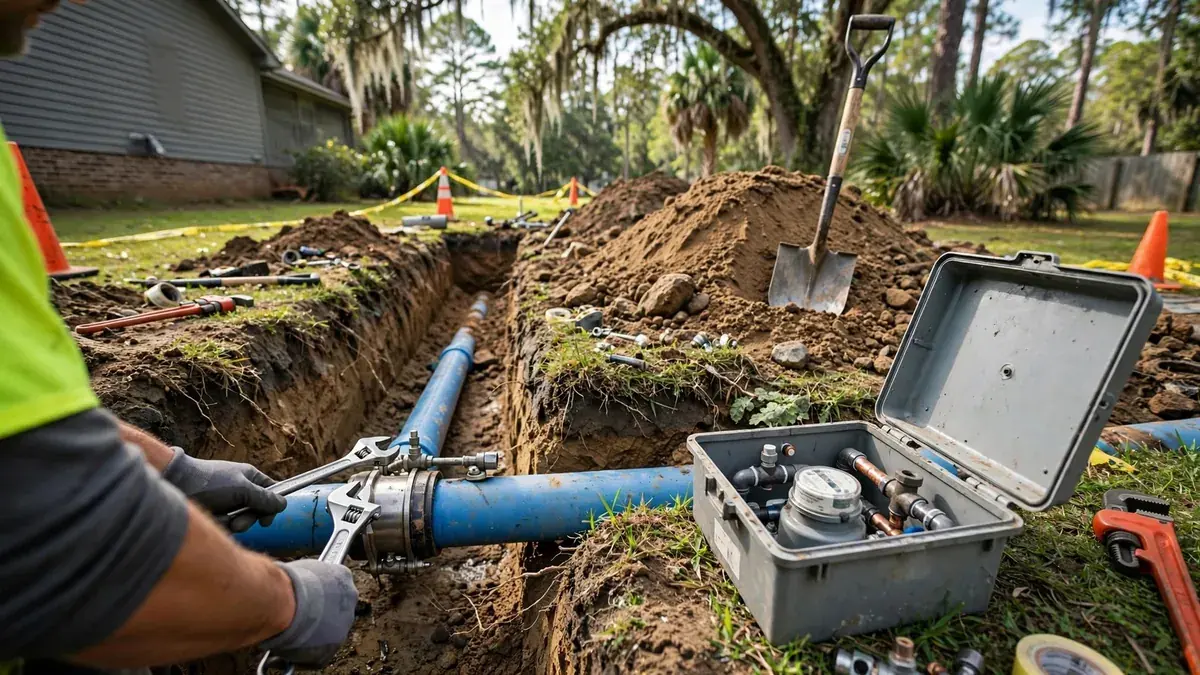
Signs the leak is under the ground
Water that escapes underground does not always rise to the surface. In loose sandy soil it can drain away quietly, so the first sign may be a bill rather than a puddle. The signs below point to a buried line, usually between the meter and the house.
Look for a patch of lawn that stays green and soggy while the rest dries out, a dip or soft spot in the ground, or water pooling near the meter box. Inside, you may notice weak pressure at every tap, or the sound of water running when nothing is on.
The simplest test is the meter. Turn off every fixture and appliance, then check whether the meter dial or leak indicator is still moving. If it is, water is going somewhere. Our guide to leak detection describes how we trace it from there.
Irrigation lines also run underground, and a broken sprinkler pipe can look like a main line leak on the meter. If your yard has a sprinkler system, close its supply and see whether the meter slows. That one step often splits the problem in half.
Leak inside the house or under the yard?
Both can drive up a bill, but they behave differently. This comparison helps you tell which is more likely.
Buried line leak signs
- Soggy or sunken ground outside
- Meter moves with all fixtures off
- Pressure falls at every tap
- Wet area near the meter box
- No stains on walls or ceilings
Inside leak signs
- Stains, bubbling paint or musty smells
- Sounds of water in a wall or floor
- A single fixture runs or drips
- Warm spots on a slab floor
- Meter still moves with everything off
Some leaks overlap, and a running toilet can imitate a buried leak on the meter. That is why a proper test isolates sections of the line instead of guessing.
What Deerfield Beach homeowners should know
The City of Deerfield Beach publishes a water service-line material inventory at dfb.city/waterline, tied to its water meter upgrade program. You can check what material your line is made of there, which helps you judge the age and condition of the pipe before a leak shows up.
Many local properties sit near the Hillsboro Canal or the Intracoastal, where the water table runs high. A high water table can hide the surface signs of a leak, so a wet yard does not always point to the break, and the meter test matters more.
Warm weather and heavy summer rain can also hide a slow leak, because the yard is often damp anyway. If the lawn looks wet after rain, do not assume the water came from the sky. Run the meter test on a dry stretch with every fixture off.
If the inventory lists your line as lead or unknown, call us to talk through replacement. We do not claim any local line is lead. We only suggest checking the list.
How plumbers find a buried leak without digging blind
The first step is isolation. We close valves to split the line into sections, then watch whether the meter keeps moving. This tells us whether the leak is before or after a given point, so we know where to focus.
Next comes acoustic listening. Leaking pressurized pipe makes a sound that travels along the pipe and through the soil. Sensitive ground microphones and listening devices pick up the loudest point, which usually sits near the leak.
Noise can mislead in some conditions. Plastic pipe carries sound poorly, and water-saturated ground muffles it, so we rarely rely on one method alone. Combining isolation, listening and pressure results gives a more reliable answer than any single tool.
Where sound is unclear, a pressure test checks that the line holds, and tracer gas or thermal imaging can help confirm the position. The goal is a small, accurate opening instead of a long trench. Once the spot is confirmed, our water service line repair work replaces the damaged section.
What to do while you suspect a buried leak
These steps keep the problem small until a plumber arrives.
- Run the meter test Shut off all water use and watch the meter for movement.
- Photograph the meter and the wet area Dated photos help show when the problem began.
- Close the main valve if water is pooling Closing the main on your side of the meter limits the loss.
- Keep digging tools out of the yard Random digging can hit other lines or damage a pipe further.
- Avoid driving over soft ground A weak area above a leak can collapse under weight.
- Call a licensed plumber Check the license through the Florida Department of Business and Professional Regulation first.
Who owns which part of the line
Ownership affects who fixes the leak, so find out before work begins. In general, the meter divides city and owner responsibility. Ask the City of Deerfield Beach utility to confirm for your property.
| Section of line | Typically responsible | What to do |
|---|---|---|
| From the main to the meter | The city utility | Report the leak to the city |
| From the meter to the house | The property owner | Call a licensed plumber to locate and repair |
| Inside the house | The property owner | Use leak detection or repair inside |
| Shared condo lines | Often the association | Report to the manager first |
| Irrigation branches | The property owner | Close the irrigation supply and have it checked |
Confirm ownership with the City of Deerfield Beach utility, since layouts and agreements differ by property.
After the leak is found
Repair choices depend on the pipe material, depth and what lies above it. A short section may be cut out and replaced. A line that has leaked more than once, or that is in poor shape, may be better replaced for a longer stretch. We explain why before any work starts.
If the leak is under a driveway, patio or slab, we plan access to disturb as little as possible. You will also want to check your policy, because insurers often cover sudden damage but usually not the worn pipe or a gradual leak.
We serve Deerfield Beach and nearby towns. For homes to the west, see our Coconut Creek page, and the service areas page lists the rest.
Buried leak questions from Deerfield Beach residents
The City of Deerfield Beach publishes a service-line material inventory at dfb.city/waterline, so you can look up the material for your property. If you cannot find it or the entry says unknown, call us and we can talk through how to confirm it.
If the inventory lists lead, call us to discuss replacement.
Yes. Soil can absorb a slow leak, so the first sign may be a rising bill. Checking the meter with everything off is the easiest way to catch it early.
No. We use listening gear and testing to locate the spot, then open only the area needed. Sometimes the line's route requires a longer opening, and we will say so ahead of time.
Not always. Water follows the easiest path through soil and along the pipe, so the wet spot can be some distance from the break. That is why we confirm the location before digging.
It can be if water is pooling, pressure has dropped or the ground is sinking. Close the main valve and call (561) 448-8545. Our leak detection team can find it, and we offer same-day appointments when available.
Policies differ, but they often cover sudden and accidental damage and usually do not pay for the repair of a worn pipe or a gradual leak. Check your policy and call your insurer early.