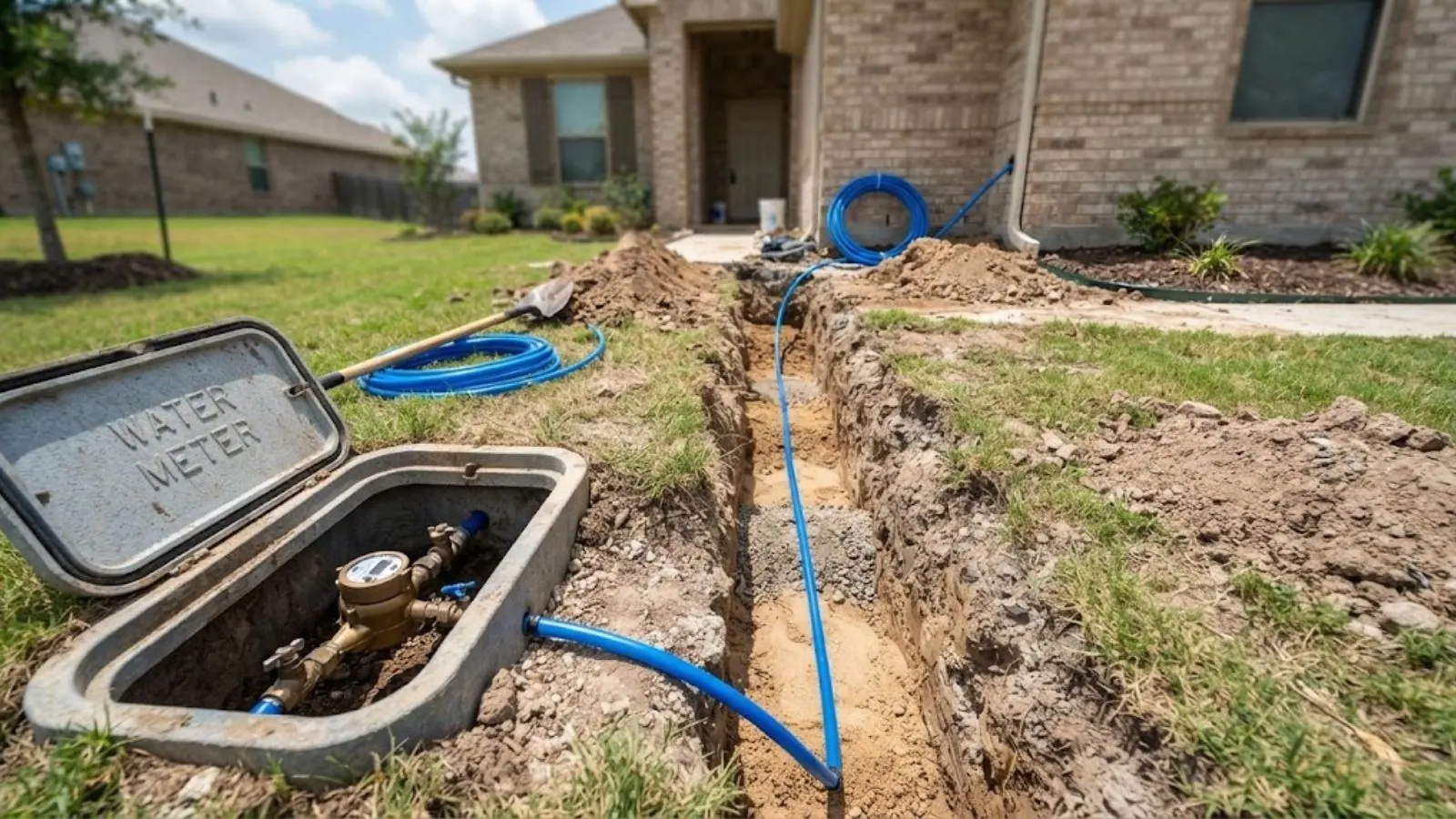
The pipe between the meter and your front door
The service line is the underground pipe that brings water from the meter to your building. You cannot see most of it, which is why trouble often shows up as a side effect. Pressure drops, the lawn stays soaked after a dry week, or a meter runs while every tap is closed.
A line can fail because of age, corrosion, ground movement, tree roots pressing on it or damage from digging. A fitting at the meter or at the house wall is a frequent weak point. The leak may be small, but it runs day and night under pressure, so the water loss adds up.
We repair a damaged section when the rest of the line is sound, and we replace the whole run when the pipe is worn throughout. Our team will tell you which one fits, and why, before work begins.
No water at the house, or water pouring from the yard
A failed service line can leave you without water or flood part of the property. A few quick actions protect the building and help us diagnose the problem faster.
Find out where the water is going
Look for a wet or sunken patch between the meter and the house. Pooling water near the meter box or along the building wall tells us where to start.
Close your own shut-off
Turn off the main valve where the line enters your building. If the valve at the meter is the utility's, leave it alone and tell us what you see instead.
Check the meter dial
With the house valve closed, watch the dial or leak indicator. If it still moves, the leak is between the meter and your valve, and the fix is on your side.
Check neighbors and the utility
If nearby homes have no water either, the problem may be a utility main issue. The City of Deerfield Beach utility can tell you whether work is underway in your area.
Keep your water bill and any photos of the wet area. They help us and your insurer see when the problem began.
Repair a section or replace the whole line
Both approaches have a place. The right call depends on the pipe, the soil and the history of the line.
Spot repair
- Fixes one cracked section or failed fitting
- Needs a smaller excavation
- Suits a line that is otherwise sound
- Costs less up front
- May not stop a second failure nearby
Full replacement
- Installs new pipe from meter to house
- Needs a longer trench or a bore
- Suits old, corroded or often repaired lines
- Costs more up front
- Resolves the line as a long-term concern
We can often bore or pull a new line to limit yard damage, but ground conditions and obstacles decide what is possible. We explain the realistic options after seeing the site.
Signs the service line is the problem
These clues point to the buried line more than to indoor plumbing.
- A meter that moves with everything off Water is escaping somewhere past the meter, and the buried line is a prime suspect.
- A wet, spongy or sunken yard patch Ground that stays soaked in dry weather often sits above a leak.
- A sudden drop in water pressure Pressure that falls across the whole house suggests a loss upstream of your fixtures.
- Dirty or sandy water A damaged line can pull in soil or stir up sediment when pressure shifts.
- A hissing sound near the meter or wall Escaping water makes noise, especially on a quiet night.
- A bill that rises with no other cause Run the meter test, and let our leak detection service find the exact spot.
No single sign proves the service line is at fault. We confirm with a pressure test and listening gear before any digging.
Low pressure: what we check and what it means
Weak water pressure is not always the service line. This table shows how we separate causes.
| What we check | What we may find | What it points to |
|---|---|---|
| Pressure at the hose bib | Low reading even at the first outlet | A line problem or a closed or partly open valve |
| Main valve at the house | A gate valve that is not fully open | A worn valve we can replace |
| Pressure regulator | Failing or set too low | A regulator replacement |
| Pressure at several fixtures | Strong in some rooms and weak in others | Clogged or corroded pipes inside the building |
| Meter and service line | Pressure drop that tracks flow | A restriction or leak between meter and house |
If the inside piping is the cause, our repiping page covers replacing it.
Who owns which part, and how to check your line
Typically the meter divides city and owner responsibility, so the line on the street side belongs to the utility and the line from the meter to your building belongs to you. Ask the City of Deerfield Beach utility to confirm for your property before you pay for any work.
The city publishes a service-line material inventory at dfb.city/waterline, tied to its water meter upgrade program, so you can check what material your line is. If the inventory lists your line as lead or unknown, call us to talk through replacement. We do not claim any particular line is lead, only that you deserve to know what is in the ground.
Wherever the line meets the meter, the details matter. A leak at the meter itself is usually the utility's to handle, and we help you work out which side it is on.
What drives the price of a service line repair
No two lines are alike, so a fair quote starts with a look at the site. We give a clear price before work starts, and these factors shape it.
Homeowners policies sometimes offer optional service line coverage, and many do not. Check your policy for a buried line endorsement, since coverage is often an add-on and not part of the standard terms.
Gradual leaks and worn pipes are often excluded. Keep your bills and our written findings in case the insurer asks.
Want your real number? Call us and describe the job.
(561) 448-8545Service line questions from Deerfield Beach property owners
Yes. Our emergency line is open 24/7, including nights, weekends and holidays, and we offer same-day appointments when available. We do not promise an exact arrival time, because it depends on where our crews are and how many calls are active.
Call (561) 448-8545 and we will help you decide what to shut off first.
The city publishes a service-line material inventory at dfb.city/waterline. Check your address there to see the listed material.
If the inventory shows lead or unknown, call us and we will talk through what replacement would involve.
Typically the meter divides city and owner responsibility, so the owner usually handles the line on the building side. Ask the City of Deerfield Beach utility to confirm for your property.
Our leak detection work can help prove which side the water is escaping from.
Sometimes. Depending on soil, depth and obstacles, a new line can be bored or pulled with limited digging. Other sites need an open trench.
We look at the site first and explain the realistic option, including what will need to be restored.
Causes include a partly closed valve, a failing regulator, a leak on the service line or clogged pipes inside the building. We test pressure at several points to tell them apart.
If the pipes inside are the issue, our repiping page explains the options.
Usually the association handles the main lines serving a building, while you handle the lines inside your unit. Check your governing documents to confirm where the boundary sits.
If you are unsure, ask your manager before calling anyone to dig.
Yes, we dispatch from Deerfield Beach to nearby Broward County towns. Our Coconut Creek page explains how service works there, and our service areas page lists others.
Give us your street and ZIP when you call so we can confirm coverage.