Start by testing your tap, not by buying equipment
Treatment equipment only makes sense once you know what it is supposed to treat. A basic hardness test strip or a lab test can tell you how much mineral content your tap water carries, and a few minutes with a kit costs far less than guessing wrong. Test at a kitchen cold tap, and test again after the water has run for a minute.
You can also ask the City of Deerfield Beach for its annual water quality report. The city's drinking water comes from groundwater, drawn from the Biscayne and Floridan aquifers through 14 active production wells, and the treatment process includes lime softening, nanofiltration and reverse osmosis streams that are blended, pH adjusted and disinfected. The report we reviewed lists no hardness figure, so we do not guess at your number. Your own test result is what counts.
Bring the numbers and your complaints to us. If the results show little to treat, we will say so and save you the expense.
Softener or filter: two tools for two different jobs
People often use the words as if they mean the same thing. They do not, and mixing them up is the most common reason a system disappoints.
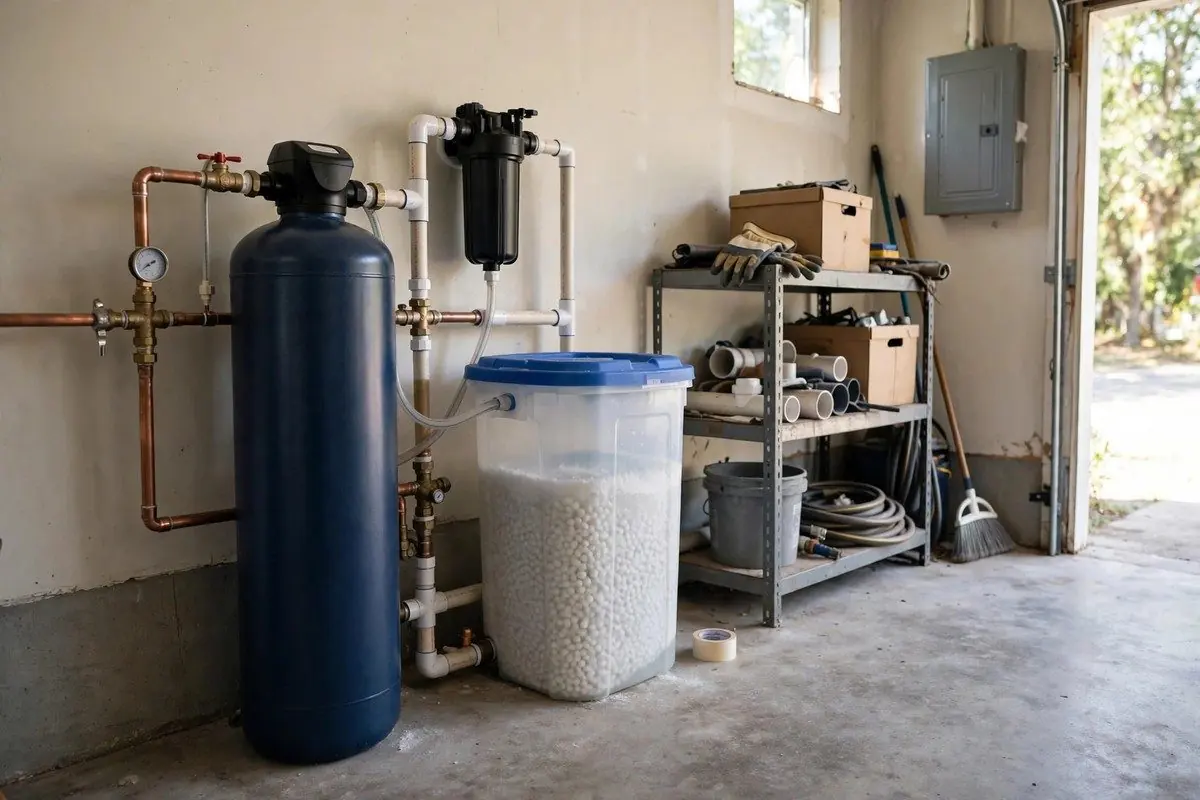
Water softener
- Uses a resin tank and salt to swap out hardness minerals
- Aimed at scale on fixtures, glass and heater elements
- Needs salt refills and an occasional cleaning cycle
- Sends a bit of wastewater to the drain during regeneration
- Does not improve taste, smell or remove chloramine
Filtration or reverse osmosis
- Uses carbon, sediment media or a membrane to treat taste, smell and particles
- Aimed at drinking, cooking and general water quality
- Needs filter or membrane changes on a schedule
- Whole-house units protect every tap, RO units usually serve one sink
- Does not remove scale-forming minerals the way a softener does
Some homes end up with both, a softener for scale and a carbon filter or an RO tap for drinking water. Others need only one. Your test results and your complaints decide.
Chloramine and the system you choose
The City of Deerfield Beach disinfects its water with chloramine, and the city switches to free chlorine for about three weeks each year. That matters because filters are not all equal. Standard carbon filters are often sold for chlorine taste, and chloramine is harder to remove, so a unit that handles one may do little for the other.
Before you buy any filter, ask whether it is rated for chloramine, and ask what flow rate and contact time that rating assumes. A filter that works on paper but strangles the flow at the kitchen sink is a poor trade. Carbon media also needs timely replacement, because an exhausted cartridge stops treating the water while still looking fine.
Reverse osmosis units use a membrane plus carbon stages and are a common pick for drinking water at one tap. They produce wastewater and need cartridge changes, and the membrane is not meant to feed the whole house.
Questions to ask before you sign for any system
A good installer welcomes questions. These keep the sales pitch honest.
- What problem does this solve? The answer should match your test results and your complaint, not a general claim about all water.
- Is it rated for chloramine? Ask for the specific rating on the product sheet, not a verbal yes.
- What does it cost to run? Salt, filter cartridges, membranes and water used for flushing all add up each year.
- Where will it go and how will it drain? Many local garages and utility closets are tight, and a softener needs a drain nearby plus a power outlet.
- What happens to my warranty and my water heater? Ask how the manufacturer and installer treat service, and have our team explain how treated water may affect the heater.
- Who services it later? A system without a plan for parts and repair becomes a bypass valve nobody uses.
- Does my building allow it? Condo and HOA rules often govern what can be added to shared water lines.
If the heater already shows signs of buildup, see our water heater repair work for sediment flushing and inspection.
Reading the symptoms at your tap
Symptoms overlap, which is why testing comes first. This table shows the most common matches.
| What you notice | Likely cause | Where to look |
|---|---|---|
| White crust on faucets and a film on glass | Mineral deposits left behind as water dries | Test your tap, then consider a softener |
| Chlorine or chemical taste and smell | Disinfectant in the water supply | Carbon filter or RO rated for chloramine |
| Cloudy ice or sediment in the aerator | Particles from pipes or fittings | Sediment filter and a look at the plumbing |
| Slow flow from a showerhead | Mineral buildup in the head or a clogged screen | Clean the head, then test the water |
| Rotten egg smell from hot water only | Often a water heater issue | Have the heater inspected before adding a filter |
A test result beats a guess, and we are happy to compare your readings to what you see at home.
Installation, repair and service visits
Whether the job is a new unit or a tired one, we follow the same plan.
- 1
Look at the water and the space
We read your test result, check the water supply entry point and find a spot with drain access, power and room to service the unit.
- 2
Choose the system
We recommend a softener, a filter, an RO unit or a combination, and we tell you what each needs in upkeep.
- 3
Install with bypass valves
We add a bypass so you can isolate the unit, connect the supply and drain lines, and set the controls. Work follows the Florida Building Code, Plumbing, and permit questions go to the City of Deerfield Beach building department. See our plumbing installation page for related work.
- 4
Test and teach
We check for leaks, test the water after treatment and show you where the bypass, the salt or the filter housing sits.
- 5
Repair old units
For an existing softener or conditioner, we diagnose the control valve, the brine tank, the resin and any clogged injector. Repair is sometimes better than replacement, and sometimes it is not, and we explain which.
How the price of a softener or filter is shaped
System prices range from a single under-sink cartridge to a whole-house tank setup, so we give a clear price before work starts after we see the space. These factors move it the most.
Water treatment is usually an upgrade, so insurance rarely pays for it. If a leak from a failed tank or fitting causes damage, a policy may respond to the sudden water damage but not the equipment itself, so check your policy.
In a condo, ask the association about approval first. If you are near us in Coconut Creek, our Coconut Creek page covers how we serve that area.
Want your real number? Call us and describe the job.
(561) 448-8545Softener and filter questions from Deerfield Beach homes
We can't tell you from the city report alone. The report we reviewed lists no hardness figure, so test your tap or send a sample to a lab to get your actual reading.
If the result shows a need and you see scale at fixtures, a softener may make sense. If not, a filter may suit you better.
Only if it is rated for it. Many carbon filters are sold for chlorine and do less for chloramine, so ask for the rating on the product sheet.
Contact time matters too, and a filter sized too small can cut the flow without doing the job.
The city switches to free chlorine for about three weeks each year. A chlorine-rated filter handles that period well, and a chloramine-rated one should cover both.
Ask the city for dates if you want to plan around it, since we do not publish them here.
Salt needs checking regularly, and the brine tank can develop a hard crust or bridge that stops regeneration. Resin wears over time, and control valves and injectors can clog.
If your unit stops soft-feeling water or the tank overflows, call us for a look.
Possibly, but ask the association first. Many buildings limit what can be added to shared lines, and a unit inside your own space still needs drain access and approval for work.
An under-sink RO unit often avoids those issues, and we can talk through both options.
Often the smell comes from the water heater, not the supply. A filter on the cold line will not change that.
Our water heater repair team can inspect the tank and its anode rod.
Yes. Our plumbing installation service covers pressure regulators, shut-off valves and the supply changes a treatment system may need.
Tell us what you have when you call.