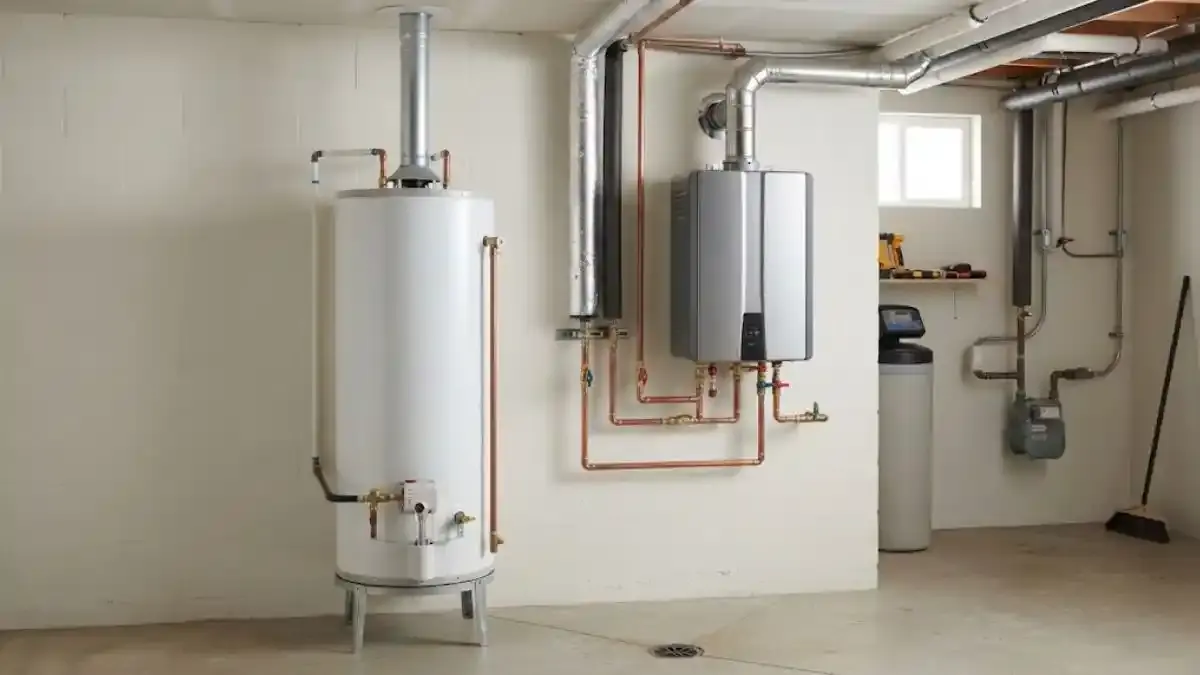
How a tankless unit differs from a tank
A tank heater keeps a set volume of water hot all day. When you use more than the tank holds, the hot water runs out until the tank recovers. A tankless unit has no storage. A flow sensor starts a burner or heating element when water moves through it, and the water leaves hot.
That design explains both the benefits and the limits. You get hot water as long as the unit can keep up with the flow, and you pay for heating only when you use it. But the unit has to deliver a lot of heat in a short time, so it needs a strong gas supply or a high-capacity electrical circuit.
Because the unit fires on demand, it also reacts to small draws differently than a tank. A very low flow, such as a slowly running tap, may not trigger the heater at all. That is normal, and a good installer explains it before the unit goes in.
Sizing for tankless is based on flow, measured in gallons per minute, and not on tank volume. The number of fixtures running at once matters more than the number of people living in the house.
Tankless and tank side by side
This table puts the main differences in plain terms. Neither type wins in every category.
| Topic | Tankless | Tank |
|---|---|---|
| Hot water supply | Continuous while flow stays within the unit's limit | Limited to the tank, then a recovery wait |
| Space needed | Compact and wall mounted | Floor space for a full tank |
| Upfront and install price | Higher, often with gas or electrical upgrades | Lower for a like-for-like swap |
| Standby heat loss | None, since there is no stored water | Some heat is lost from stored water |
| Maintenance | Regular descaling and filter cleaning | Tank flushing and anode rod checks |
| Failure risk | No tank to flood the room | A failed tank can release the full volume |
The right pick depends on how you use hot water and what your home can support.
The benefits that hold up in real homes
Steady hot water is the benefit most households feel. A family that runs back-to-back showers, laundry and a dishwasher will not hit a cold stretch as long as the unit is sized for peak demand. Space savings matter too, especially in a narrow closet or a tight utility room.
There is also no big tank to rust through, which removes the flood risk that comes with an aging tank. Some people also like that a tankless unit does not waste energy keeping a full tank warm while nobody is home.
In South Florida, incoming water is warm for much of the year, so a tankless unit often has less temperature rise to deliver. That can ease the load on the heater, though results depend on the unit and your usage, so ask for sizing based on your house and not a general claim.
What Deerfield Beach homeowners should know
Deerfield Beach has no freeze risk, so tankless units here do not need the cold-weather protection that heaters in northern climates need. That keeps outdoor or garage mounting simpler, though salt air near the coast can still age exposed metal parts, so ask about protection if you live close to Main Beach or The Cove.
Many homes and condos sit on slabs, with the heater in a garage, closet or utility room. A tankless unit's smaller size can make that space more usable, but it still needs clearance and venting, so a site check matters.
Hurricane season runs June through November, and storms can cause power outages. Electric tankless units and the controls on gas units need power, so ask what your unit does when the power returns and have the controls checked if the area flooded.
In a condo or HOA community, ask the association before you change the type of heater. Venting, gas lines and wall mounting may fall under building rules.
Questions to settle before you choose tankless
Go through these in order. If you hit a problem at any step, it is better to find out before purchase.
- 1
Count peak hot water use
List which fixtures can run at the same time, such as two showers and a kitchen tap. This sets the flow your unit must handle.
- 2
Check fuel and capacity
Gas units need enough gas line capacity and a safe vent path. Electric units need a circuit and panel space that can carry the load.
- 3
Look at the location
Many local homes have the heater in a garage, closet or utility room. Make sure the spot allows clearances, venting and service access.
- 4
Plan for maintenance
Mineral buildup depends on your water, so ask the city for its water quality report, test your tap and set a descaling plan with your plumber.
- 5
Compare total cost, not just price
Add installation work, upgrades, upkeep and expected lifespan before you decide.
Drawbacks worth weighing honestly
The upfront cost is the most common drawback. The unit costs more, and the installation often requires a larger gas line, a new vent, or a new electrical circuit. That work is useful but adds up.
Tankless units also can run short if too many fixtures open at once, and they take a moment to deliver hot water at a far tap. Descaling is a recurring job. Skipping it can lower performance and may trigger error codes.
If you want a simple like-for-like swap in a closet that suits a tank, a tank heater can be the more practical choice. For planned installs, see our water heater installation page.
Is tankless right for your Deerfield Beach home?
Tankless is a good fit when most of these are true.
- Hot water runs out often You regularly use more than a tank holds during busy hours.
- Space is tight A wall-mounted unit would free up a closet or garage corner.
- Your home can support it Gas line or electrical capacity is adequate or can be upgraded.
- You will keep up maintenance You are ready to flush or descale the unit on a schedule.
- You plan to stay a while A longer stay helps spread the higher purchase price over time.
- Your association allows it Condo and HOA rules do not block a change of heater type.
If you decide to go ahead, our tankless water heater page describes sizing, venting and maintenance. We also serve homes to the west, and our Coconut Creek page covers that area, while the service areas page lists the rest.
Tankless questions from Deerfield Beach residents
It can, if your association allows it and your unit has the venting and gas or electric capacity. Space in a condo closet is often tight, which makes a compact unit attractive.
Ask the association first, because shared walls, vent paths and utility lines may be under building rules. We can look at the closet and tell you honestly whether it will work.
Hot water continues as long as the flow stays within the unit's rating. If too many fixtures open at once, the temperature can drop. Proper sizing is what prevents that.
It depends on your water and your usage. The city report we reviewed lists no hardness figure, so we suggest testing your tap and asking the city for its annual water quality report. Then we can set a schedule that fits.
Sometimes, but often the gas line, vent or electrical circuit needs an upgrade. A site visit shows what your home needs before a quote is final.
Codes often point to venting, ignition, flow or scale problems. Our water heater repair team can read the code and find the cause.
Maybe not. If your tank meets your needs and fits your space, a tank is the simpler and cheaper route. Call (561) 448-8545 and tell us how you use hot water so we can give a straight opinion.