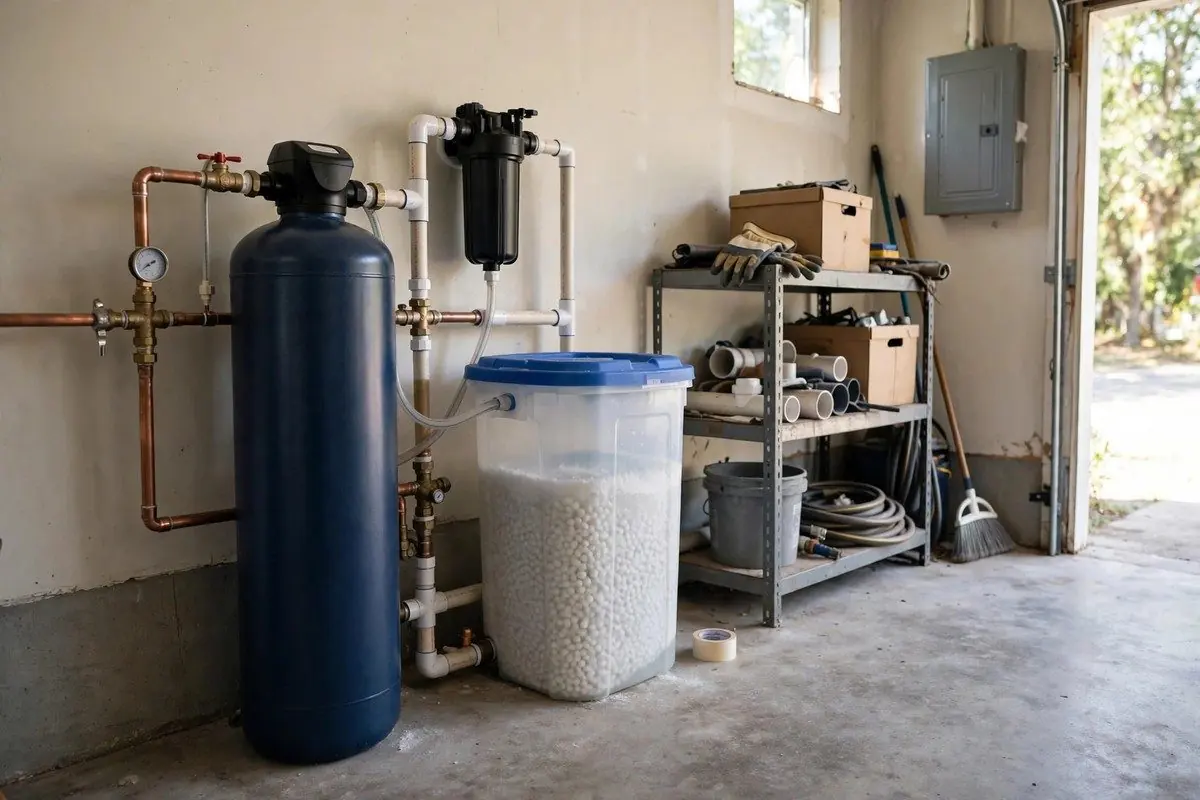
Why price depends on the problem, not just the box
People often ask for a softener when they notice white crust on faucets, spots on glass or a film on shower doors. Those signs can point to mineral buildup, but they can also come from other causes, and a taste or odor complaint has nothing to do with minerals at all.
A quote is only meaningful when it matches a measured problem. A hardness test strip or a water test from a lab tells you what is in your water, and it is the starting point for sizing any system. We recommend doing it before you spend anything.
Be careful with free in-home water tests offered alongside a sales visit. A test is useful, but the result should come with a plain written number, and you can repeat it with a store kit or a lab sample to check. If two tests disagree, trust the one you can explain.
The price then follows from three questions. What does the system need to remove, how much water does the household use, and how hard is the job of fitting it into the plumbing. The next sections walk through each.
Softener, filter or reverse osmosis: which one are you pricing?
These three get mixed up in sales pitches, and they do different jobs.
Whole-house softener
- Reduces minerals that cause scale
- Uses salt and a regeneration cycle
- Installed on the main line, so it treats the whole house
- Needs a drain connection and a power outlet nearby
- Does not improve taste or remove chloramine on its own
Filter or reverse osmosis
- Filters target taste, odor, sediment or specific contaminants
- Whole-house filters treat all water, while RO treats drinking water
- RO fits under the sink or at a kitchen tap
- Filters need cartridges changed on a schedule
- Ask whether the media is rated for chloramine
Some homes end up with two systems, one for scale and one for drinking water. If a seller recommends both, ask what each is meant to fix.
What Deerfield Beach homeowners should know
The City of Deerfield Beach draws drinking water from groundwater, the Biscayne (surficial) aquifer and the Floridan aquifer, through 14 active production wells. Its treatment includes lime softening, nanofiltration and reverse osmosis streams that are blended, pH adjusted and disinfected, according to the 2025 Consumer Confidence Report. The report we reviewed lists no hardness figure, so test your tap and ask the city for its annual water quality report.
The city's disinfectant is chloramine, and it switches to free chlorine for about three weeks each year. If you want a filter or RO system for taste or odor, ask whether the product is rated for chloramine, because some filters only handle free chlorine.
Many local homes and condos are built on concrete slabs, so there is often limited space for a softener, a salt tank and a drain. In a condo, the association may control where equipment and drains can go.
The cost drivers behind any quote
System size is the first driver. A larger household with more bathrooms and heavier water use needs a bigger unit, and a bigger tank or media bed costs more to buy and to run. Oversizing wastes salt, and undersizing leaves you with the problem you started with.
The second driver is installation. A softener near the water entry point with a drain and outlet close by is a simple job. A unit that needs new pipe runs, a bypass valve, a drain extended across a garage or an outlet added is more work.
The third driver is which pieces the job adds, such as a pressure regulator, shut-off valves, a sediment pre-filter or a new drain line. Each addition is a separate part and labor line, and a good quote lists them. Our water softener and filtration service begins with questions about your fixtures and your goals before we suggest a system.
What a clear quote should itemize
Use this list when you compare two or three bids. If a line is missing, ask.
- The reason for the system The quote should name the problem, such as scale, taste or odor, and tie it to a test.
- The unit and its capacity Look for size, type and what it is rated to treat.
- Installation scope It should list the pipe work, valves, drain and electrical connections included.
- Chloramine rating If you want taste or chlorine and chloramine reduction, ask whether the media is rated for chloramine.
- Ongoing needs Salt, filter cartridges, membrane changes and any service visits should be described.
- Removal and cleanup If an old unit is being removed, say so.
Ask about the warranty terms in writing too. A verbal promise helps nobody a year later.
Ongoing costs that surprise buyers after the install
The purchase is not the whole expense. Think about what you will keep paying for.
| System | What you keep buying | What to plan for |
|---|---|---|
| Whole-house softener | Salt, plus water used for regeneration | Refilling the brine tank and checking for salt bridges |
| Sediment or carbon whole-house filter | Replacement cartridges | Changing them on schedule so flow stays strong |
| Reverse osmosis drinking system | Pre-filters and a membrane | Replacing stages and sanitizing the system |
| Combined systems | All of the above | A maintenance calendar that covers each stage |
| Valve and electronics | Occasional repair or replacement | Service when the head or timer fails |
A system that is easy to service tends to cost less to keep running.
Condo and HOA rules may limit where a softener or drain can go. Ask your association before you order equipment.
Install, repair and when a simple add-on is enough
When a softener, filter or conditioner already exists, many problems come from the valve head, the brine system or worn cartridges rather than a failed tank. Repairing a valve can cost far less than replacing the unit, and we will say so if that is the case. If minerals are building up in the water heater, our water heater repair visit can also check the tank and flush sediment.
New equipment is a plumbing job as much as an equipment job. Drain lines, shut-off valves, a bypass and a dedicated outlet all matter. Our plumbing installation work covers the connections, and permit rules vary, so ask the City of Deerfield Beach building department whether your project needs one.
If a quote seems high, ask us to explain each line. A real price follows the work, and it should not need a sales deadline.
Water softener questions from Deerfield Beach homeowners
We cannot say without a test of your tap. The city's report that we reviewed lists no hardness figure, and the city's treatment includes lime softening.
Test your water, ask the City of Deerfield Beach for its annual water quality report, and decide from the result rather than from a sales pitch.
A softener reduces minerals that cause scale on fixtures and heaters. A filter targets sediment, taste, odor or other contaminants.
A reverse osmosis system treats drinking water at a single tap, and it does not protect the whole house from scale.
Not by itself. A softener works on minerals, while taste and odor are usually addressed by a carbon filter or a reverse osmosis system.
If taste is the complaint, say so when you ask for a quote.
Ask for the product's rating in writing. Some media only reduce free chlorine, and the city uses chloramine as its disinfectant.
Our water softener and filtration team can help you read the specifications.
Sometimes. You need space for the unit and a drain, and your association may have rules on equipment, drains and work on shared lines.
Ask the association first and tell us what it says.
Yes, we dispatch from Deerfield Beach to nearby Broward County towns. See our Coconut Creek page and our service areas for details.
Call (561) 448-8545 with your street and ZIP to confirm.